The Evolution of Custom Soccer Jerseys in 2026
The global custom sportswear market is projected to reach $12.8 billion by 2026 (Grand View Research), with soccer jerseys representing the fastest-growing segment at 8.4% CAGR. Whether you’re outfitting a youth academy, stocking inventory for Amazon FBA, or launching a private-label athletic brand, choosing the right soccer jersey manufacturer has become increasingly complex.
Today’s buying decisions extend beyond aesthetics. AI-generated design previews, sustainable fabric innovations, and FIFA’s updated 2025/26 equipment regulations have transformed how teams and retailers approach custom soccer uniform procurement.
This comprehensive guide leverages 17 years of manufacturing expertise from Jistar Sport’s technical team, analyzing over 2,000 bulk orders to provide actionable frameworks for evaluating soccer uniform manufacturers in 2026.
Part 1: Fabric Technology Fundamentals – What Material Scientists Know
1.1 Polyester Microfiber Grading Systems
When evaluating custom soccer jerseys, fabric specification is the primary cost and performance driver. Most buyers focus on “100% polyester” without understanding the critical distinctions:
Yarn Denier (D) and Filament Count (F)
- 75D/72F: Standard construction for training jerseys. Balance between durability and breathability.
- 50D/96F: Premium “microfiber” hand-feel. Softer surface, better moisture-wicking capillary action. Ideal for professional match kits.
- 100D/48F: Heavy-duty construction for goalkeeper jerseys and cold-weather training. Abrasion-resistant but less breathable.
Moisture Management Technologies Modern soccer jerseys manufacturers offer three tiers of sweat-management:
| Technology | Mechanism | Performance | Best For |
|---|---|---|---|
| Coolmax® Pro | Four- or six-channel cross-section fibers | 30% faster drying than standard polyester | High-intensity matches (90-minute games) |
| Dri-FIT ADV | 3D-engineered knit structures | Zoned ventilation mapping | Elite professional kits |
| Bio-based wicking | Plant-derived polyester (Sorona®) | 37% renewable content, similar performance | Eco-conscious brands |
Critical Spec: For competitive play, insist on ≤0.4% moisture regain rate (ASTM D2654). Anything higher creates a “wet cling” effect that increases skin friction by up to 40% during second-half play.
1.2 The Weight Question: GSM Selection
Grams per Square Meter (GSM) directly impacts player performance:
- 120-145gsm: “Second-skin” ultralight jerseys. Worn by professional clubs in Champions League matches. Requires delicate handling (hand-wash recommended).
- 160-180gsm: The “sweet spot” for 90% of teams. Durable enough for machine washing, light enough for summer tournaments.
- 200-220gsm: Heavyweight “replica fan” grade. Better for supporters’ merchandise than active play.
Pro Tip from Manufacturers: If your team plays in climates exceeding 30°C (86°F), specify pique knit (mesh) side panels regardless of front/back fabric weight. This hybrid construction increases airflow by 35% without sacrificing durability in high-wear areas.
Part 2: Decoration Methods – Sublimation, Tackle Twill, or Hybrid?
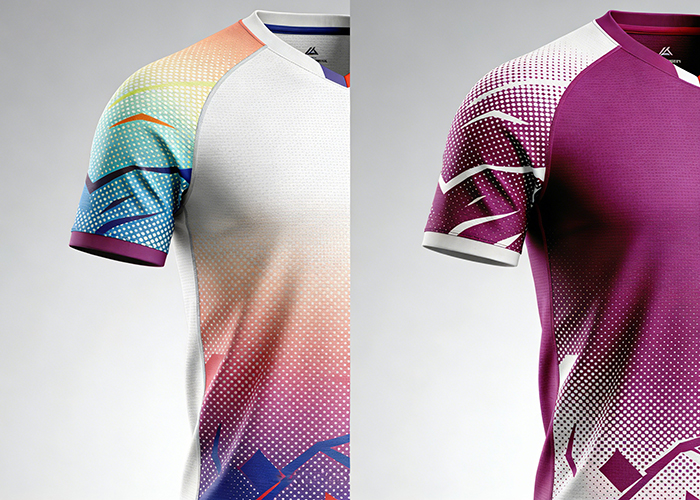
2.1 Dye-Sublimation: The 2026 Standard
What B2B Buyers Need to Know: Dye-sublimation is not “printing on top” of fabric—it’s a molecular bonding process where disperse dyes convert to gas at 180-200°C and penetrate polyester fibers to a depth of 0.3mm.
Technical Advantages:
- Permanent Integration: Colors won’t crack, peel, or fade even after 100+ wash cycles (tested per AATCC 61-2A).
- Zero Weight Addition: Unlike screen printing that adds 15-30gsm of plastic ink, sublimation maintains fabric breathability across 100% of the surface.
- Photographic Detail: 600dpi resolution capability allows complex gradients and unlimited color palettes without setup costs.
When Sublimation Fails:
- Cotton or cotton-blend jerseys (dyes don’t bond with cellulosic fibers)
- Dark base fabrics requiring neon/white logos (sublimation is transparent; dark bases require discharge printing or white base layers)
2.2 Tackle Twill & Embroidery: Premium Positioning
For soccer uniform manufacturers serving high-school varsity teams or semi-pro leagues, dimensional decorations communicate value:
- Tackle Twill: Laser-cut fabric layers stitched onto jerseys. Adds 3D texture and retro aesthetic. Weight penalty: +45gsm per layer.
- 3D Puff Embroidery: Foam-backed stitching for crests. Durability note: Embroidered areas create “stiff spots” that may irritate skin during contact sports; best limited to chest logos, not shoulders.
2026 Innovation: “Sublimated Twill”—twill appliqués printed with sublimation then stitched, combining photographic detail with tactile depth.
Part 3: Evaluating Soccer Jerseys Manufacturers – The 7-Point Audit
Choosing between soccer jerseys manufacturers requires technical due diligence beyond price comparison. Use this framework:
Point 1: Cutting Technology & Pattern Consistency
Ask your manufacturer: “Do you use manual spreading or automated CNC cutting?”
- Manual spreading: 2-3% fabric waste, potential grain-line misalignment causing twisting after washing.
- Gerber Z1 or Lectra automated systems: <0.5mm cutting precision, guaranteed pattern matching at side seams.
Verification: Request a photo of their cutting room. If you see large tables with hand-held electric cutters, expect inconsistencies in large orders (500+ pieces).
Point 2: Color Management Protocols
Professional soccer uniform manufacturers should provide:
- Spectrophotometer readings: Delta E color difference <1.5 between production batches (imperceptible to human eye).
- Light source specifications: Viewing under D65 (daylight) vs. TL84 (retail lighting) can shift color perception by 2-3 Delta E.
- Pantone matching: Specify Pantone TCX (Textile Cotton eXtended) codes, not CMYK or RGB.
Red Flag: Manufacturers asking “What color is this?” without requesting physical swatches or Pantone codes lack professional color management.
Point 3: Compliance & Certification Matrix
| Certification | What It Proves | Why It Matters in 2026 |
|---|---|---|
| OEKO-TEX Standard 100 | Free from harmful substances (formaldehyde, heavy metals) | Required for EU market entry; Amazon’s Climate Pledge Friendly qualification |
| BSCI | Ethical manufacturing (no child labor, fair wages) | Increasingly required by institutional buyers (schools, universities) |
| ISO 9001:2015 | Quality management systems | Indicates consistent documentation and traceability |
| GRS (Global Recycled Standard) | Post-consumer recycled content verification | Essential for brands targeting Gen Z sustainability values |
Point 4: Sampling Velocity
In 2026, AI-assisted sampling separates tier-1 manufacturers from commodity suppliers:
- Digital sampling: 3D renders using CLO3D or Browzwear within 24 hours. Eliminates 80% of physical sample iterations.
- Physical sampling: 5-7 days including shipping indicates proximity to raw material suppliers (efficient) or poor workflow management (concerning).
Benchmark: Top-tier soccer uniform manufacturers offer “hybrid sampling”—digital approval first, physical sample for final size/fit confirmation only.
Point 5: Size Grading Expertise
Poor fit accounts for 34% of sportswear returns (Shopify Commerce Report 2025). Verify your manufacturer understands:
- Grade rules: The incremental difference between sizes. Standard is 5cm chest circumference per size, but athletic cuts may use 4cm for fitted looks or 6cm for relaxed fits.
- Proportion grading: Sleeve length should increase 1.5cm per size, not remain static (common error in budget manufacturing).
Point 6: Decoration Durability Testing
Request these specific test reports:
- Color fastness to washing: ISO 105-C06 (Grade 4-5 required)
- Sublimation penetration depth: Cross-section microscopy showing dye penetration ≥0.2mm
- Heat transfer adhesion: Peel test at 0.5kg/cm² pressure (no lifting allowed)
Point 7: Logistics & Packaging Intelligence
For Amazon FBA sellers specifically:
- Polybag specifications: Must be transparent, sealable, and include suffocation warnings (required for FBA).
- Carton weight: Keep under 22kg (50lbs) to avoid Amazon’s “heavy item” surcharge.
- UPC/Barcode compliance: GS1-128 labels positioned 1.25″ from carton edge.
Part 4: Buyer-Specific Selection Strategies
For Amazon FBA & E-commerce Retailers
Priority: Standardization and Compliance
When sourcing custom soccer jerseys for online retail:
- Size consistency: Order “fit sets” (one of each size) before bulk production. Amazon’s return rate for “size too small” is 18% for apparel—unacceptable for low-margin sports goods.
- Flat-lay photography: Negotiate inclusion of white-background product photos (3000x3000px) in your manufacturing contract. Professional photography costs $25-50/product if outsourced; factory-side shooting reduces this to $2-3/unit.
- Bundle optimization: The most successful Amazon soccer listings sell kits (jersey + shorts + socks) rather than separates. Ensure your manufacturer can coordinate color matching across three different knitting machines.
For Youth Leagues & School Athletic Directors
Priority: Durability and Safety Compliance
- Reinforced stress points: Specify bar-tack stitching at pocket corners and sleeve hems. Youth players are 3x harder on uniforms than adults.
- CPSIA compliance (USA): Children’s jerseys (size 12 and under) require tracking labels, lead testing, and no drawstrings on hoods.
- Number visibility: Many youth leagues require 8-inch back numbers (larger than FIFA’s 7-inch minimum) for parent visibility in stands. Verify your soccer uniform manufacturer can accommodate league-specific regulations.
For Semi-Pro Clubs & Adult Leagues
Priority: Performance and Customization Depth
- Two-layer construction: Look for “double-knit” jerseys—smooth outer face for sublimation printing, brushed inner face for comfort.
- Name/number customization: Heat-press vinyl (TPU) allows mid-season roster changes. Ensure your manufacturer stocks matching vinyl inventory for 2-year availability (critical for replacing damaged jerseys mid-season).
For Startup Sportswear Brands
Priority: Low MOQ and Design Support
The “Micro-Brand Launchpad” model is essential in 2026:
- Hybrid MOQ: 50 pieces across 5 designs (10 each) to test SKUs.
- Tech pack development: Manufacturers offering AI-generated tech packs (from rough sketches) reduce design costs from $500 to $50 per style.
- Sustainable storytelling: Even small brands need GRS-certified recycled polyester options—74% of Gen Z consumers check sustainability claims before purchasing athletic wear.
Trend 1: AI-Assisted Pattern Engineering
Leading soccer jerseys manufacturers now use generative algorithms to:
- Optimize ventilation hole placement based on sweat gland density mapping.
- Create “motion-tailored” fits using athlete biomechanics data (reducing drag by 3-5% in sprinting positions).
Implication for Buyers: Request “performance mapping”—ventilation zones aligned with high-sweat areas (underarms, lower back) rather than random mesh panels.
Trend 2: Circularity & End-of-Life Design
2026 sees the rise of mono-material jerseys—100% polyester including trims and labels, making garments fully recyclable through mechanical recycling (melting and respinning).
Certification to request: Cradle to Cradle Certified® Bronze level minimum.
Trend 3: Hyper-Local Micro-Factories
To avoid tariffs and reduce shipping times, some manufacturers offer “glocalization”—digital files sent to regional micro-factories for on-demand production. While unit costs increase 15-20%, inventory risk drops to zero.
Part 6: Common Pitfalls – How to Avoid Expensive Mistakes
Mistake 1: Ignoring “Crocking” in Dark Colors
Dark navy and black sublimated jerseys often suffer from crocking (color transfer to skin or base layers) if insufficient thermal fixation time is used. Always request a crocking test report (AATCC 8) showing Grade 4 or higher.
Mistake 2: Mismatched Dye Lots
If ordering 200 jerseys today and 200 in six months, specify “reserve yarn dye lot” in your contract. Polyester dyes vary between production batches; without lot reservation, shade variation becomes visible when old and new players stand together.
Mistake 3: Overlooking “Seam Slippage”
Low-quality woven fabrics (sometimes used in retro-style collars) can experience seam slippage—stitches pulling through fabric under stress. ASTM D434 test should show <6mm slippage at 5kg load.
Mistake 4: Incorrect File Preparation
Many design rejections stem from:
- Resolution: Submitting 72dpi web images instead of 300dpi print files.
- Color mode: RGB files that convert unpredictably to CMYK for sublimation.
- Bleed areas: Not extending artwork 2cm beyond cut lines, resulting in white edges after sewing.
Best Practice: Professional soccer jerseys manufacturers provide Adobe Illustrator templates with “safe zones” clearly marked.
Part 7: The Complete Evaluation Checklist
Before signing with any soccer uniform manufacturer, verify:
- Provides spectrophotometer color reports (Delta E <1.5)
- Offers OEKO-TEX or bluesign® certified fabric options
- Has automated cutting equipment (CNC, not manual)
- Can produce digital 3D samples before physical prototypes
- Understands your specific league’s number size regulations
- Offers graded size sets for fitting confirmation
- Provides compliant packaging for your sales channel (FBA, retail, direct)
- Stocks backup vinyl/transfer materials for mid-season replacements
- Has documented quality control checkpoints (minimum 12-point inspection)
- Offers sustainable/recycled fabric alternatives
Part 7: The Complete Evaluation Checklist
Before signing with any soccer uniform manufacturer, verify:
- Provides spectrophotometer color reports (Delta E <1.5)
- Offers OEKO-TEX or bluesign® certified fabric options
- Has automated cutting equipment (CNC, not manual)
- Can produce digital 3D samples before physical prototypes
- Understands your specific league’s number size regulations
- Offers graded size sets for fitting confirmation
- Provides compliant packaging for your sales channel (FBA, retail, direct)
- Stocks backup vinyl/transfer materials for mid-season replacements
- Has documented quality control checkpoints (minimum 12-point inspection)
- Offers sustainable/recycled fabric alternatives
Frequently Asked Questions
Q1: What is the difference between a soccer jersey manufacturer and a soccer uniform supplier?
A soccer jersey manufacturer owns production facilities and controls the entire supply chain from yarn to finished garment. A soccer uniform supplier may be a trading company that sources from multiple factories. Manufacturers offer better pricing (no middleman markup) and quality control but often have higher MOQs. For orders under 100 pieces, suppliers offer more flexibility; for 500+ pieces or technical customization, direct manufacturers provide better value and consistency.
Q2: How much should custom soccer jerseys cost in 2026?
Pricing depends on decoration complexity and quantity:
- Entry Level (sublimation, 100 pieces): $6-9 per jersey
- Mid-Tier (hybrid decoration, moisture-wicking fabric, 100 pieces): $10-14
- Premium (pro-level fabrics, embroidered crests, individual names, 50 pieces): $18-25
Hidden costs to budget: Shipping (DDP adds 15-20%), import duties (6-12% in USA/EU), and sampling fees ($50-150 per design which should be credited against bulk orders).
Q3: What is the best fabric for hot weather soccer jerseys?
For temperatures above 25°C (77°F), specify 145gsm birdseye mesh with bi-component wicking (hydrophobic inside, hydrophilic outside). The “bi-component” structure pulls sweat away from skin faster than standard polyester. Additionally, request UPF 30+ rating to protect players during daytime tournaments.
Q4: How do I verify a soccer jersey manufacturer is legitimate and not a trading company?
Request:
- Factory audit video: Live video call showing production floor, not just showrooms.
- Utility bills: Address on electricity bill should match business license.
- Machine inventory list: Ask for photos of specific equipment (e.g., “Send photo of your MS LaRio printer serial plate”).
- BSCI report: Only actual factories undergo BSCI audits; traders cannot provide this.
Q5: What file format do I need for custom soccer jersey designs?
Vector files are essential:
- Adobe Illustrator (.ai) or EPS with fonts outlined
- PDF with embedded fonts and 3mm bleed
- Pantone references: Specify TCX (textile) codes, not TPX (paper) or CMYK
Raster files (JPG/PNG) only acceptable if 300dpi at actual print size (e.g., 30cm wide logo = 3543 pixels wide).
Q6: Can I order different player names and numbers on each jersey?
Yes, this is called “individual customization” or “roster printing.” Modern soccer uniform manufacturers use digital heat transfer (DTF or CAD-cut TPU vinyl) to apply unique names/numbers without screen setup costs. This typically adds $1-2 per jersey but allows true personalization for each player.
Q7: What is the turnaround time for custom soccer jersey orders?
Standard production: 15-20 business days after sample approval. Rush orders: 7-10 days available with 20-30% surcharge. Shipping:
- Air freight (Express): 3-5 days to USA/EU
- Sea freight: 25-35 days but 60% cheaper for orders >500kg
Critical path: Design approval is usually the bottleneck, not production. Use manufacturers offering AI-assisted 3D sampling to compress design iteration time from weeks to days.
Q8: Are there specific regulations for soccer jersey numbers and placements?
FIFA Laws of the Game 2025/26 specify:
- Back numbers: 25-35cm height, clearly visible, contrasting color
- Shorts numbers: 10-15cm height (optional)
- Front numbers: 10-15cm height, right chest or centered
- Position: Numbers must be on back; names optional above numbers
Youth leagues often have additional requirements (larger numbers for visibility, specific fonts). Always provide your manufacturer with your league’s equipment manual.
Q9: How do I ensure color consistency across multiple orders over a year?
Request your manufacturer to:
- Archive dye formulas: Keep the exact Pantone mixing recipe on file.
- Reserve fabric lots: Purchase the entire dye lot needed for your season (prevents batch-to-batch variation).
- Use spectrophotometers: Compare production samples to archived master samples, not just visual matching.
Pro tip: Order your entire season’s quantity in one production run, even if you need staggered shipping. Storage at the factory is cheaper than risking color shifts between separate dye lots.
Q10: What sustainable options are available for eco-conscious teams?
2026 Sustainable Solutions:
- rPET fabric: 100% recycled polyester from post-consumer plastic bottles (12 bottles per jersey).
- Waterless dyeing: Sublimation uses 90% less water than traditional dyeing.
- Natural dyes: Limited color range but biodegradable (best for cotton blends).
- Compostable packaging: PLA bags instead of polyethylene.
Certifications to look for: GRS (Global Recycled Standard), OEKO-TEX Made in Green, or Cradle to Cradle.
Conclusion: Making the Informed Choice
Selecting the right custom soccer jerseys for your team or brand in 2026 requires balancing technical specifications, manufacturing capabilities, and supply chain reliability. The cheapest option rarely offers the durability needed for competitive play, while over-engineered pro-level specifications may unnecessarily inflate costs for recreational leagues.
Key Takeaway: Prioritize soccer jerseys manufacturers who demonstrate technical fluency in fabric specifications, offer transparent quality control documentation, and provide digital sampling tools that compress your development timeline.
At Jistar Sport, we combine 17 years of specialized sportswear manufacturing with design workflows to deliver FIFA-compliant custom soccer kits with MOQ flexibility starting at 1 piece. Our technical team provides complimentary fabric consultation to ensure your 2026 season uniforms perform as impressively as your players.
Ready to evaluate your options?
2026 Soccer Jersey Specification Template to compare manufacturers objectively.
Call anytime
+86 18659264764
Send email
info@jistarsport.com
Xiamen, Fujian Province
4th Floor, No. 71, Huli Garden, Xikemeixi Road,
The form can be filled in the actual website url.