The Complete Guide to Custom Football Jerseys

> What turns a group of players into a united team, a symbol of pride and identity both on and off the field?
It’s more than just shared goals or a common playbook. It’s the jersey. A custom football jersey is not just a piece of clothing; it’s the armor a team wears into battle, a banner that carries its history, and a canvas for its spirit. It brings players together, intimidates opponents, and connects fans to the heart of the game. Yet, the process of creating that perfect jersey—from a spark of an idea to a field-ready reality—can feel overwhelming. This guide changes that. We will walk you through every step of designing and ordering custom football jerseys, making the choices clear and helping you create a uniform that truly represents your team.
The Power of a Unified Look
Choosing to create custom football jerseys is a decision that pays off far beyond simply meeting league requirements for a uniform. It’s a smart investment in your team’s identity and performance. Over our years of outfitting teams, we’ve seen firsthand how a well-designed, unified look can completely change a team’s path. The benefits are both real and mental, creating a powerful foundation for success.
- Boosting Team Spirit & Identity
A custom jersey gives a team its visual identity. When players put on a jersey that was designed specifically for them—with their colors, their logo, their shared symbol—it creates an immediate sense of belonging and unity. This shared identity strengthens team bonding, boosts morale, and reminds each player that they are part of something bigger than themselves.
- Projecting a Professional Image
Whether you are a school team, a corporate league, or an amateur club, a professional appearance commands respect. Custom jerseys signal that your organization is serious, organized, and invested in its players. For opponents, it presents a strong, unified front. For sponsors, parents, and administrators, it reflects a level of professionalism that inspires confidence and pride.
- Enhancing Fan Engagement & Memorabilia
Jerseys are the primary link between a team and its supporters. A unique, well-designed custom jersey becomes a desired item for fans, friends, and family. It’s a piece of memorabilia that carries memories of a great season, a championship win, or simply the joy of the game. This creates a stronger community around the team and can even become a source of revenue through merchandise sales.
- Uniqueness & Brand Control
Off-the-shelf stock jerseys are generic. They limit your ability to express what makes your team unique. Customization gives you complete control over your brand. You choose the exact colors, create a meaningful crest, and decide on the style that best fits your team’s personality. This uniqueness makes your team instantly recognizable and sets you apart from the competition.
Designing Your Perfect Jersey
The design process is where your team’s identity comes to life. It’s the most creative and rewarding part of the journey. Over the years, we’ve seen that the most successful and memorable designs always start with a strong core concept. Don’t just think about what looks cool; think about what it means. We’ve broken the process down into five manageable steps to guide you from a blank canvas to a complete design.
Step 1: Define Your Concept
Before you pick a single color or font, ask the most important question: what story do we want our jersey to tell? A great jersey is more than a collection of design elements; it’s a story. This is your opportunity to embed the team’s soul into the fabric. Think beyond the standard mascot.
- Is there a piece of local history or a landmark that defines your community? A silhouette of a mountain range on the sleeve, a pattern inspired by a city bridge, or a subtle texture drawn from a local legend can create a deep connection.
- What are your team’s core values? If you’re known for tough defense, maybe a design with sharp, angular lines is appropriate. If your identity is built on speed and fluid play, perhaps flowing, organic shapes better represent you.
- Do you have a team motto or a rallying cry? This can be subtly placed on the inside collar or the back of the neck, serving as a private reminder to the players of what they stand for.
Brainstorming these ideas first will give your design a purpose and a direction, making every subsequent choice more meaningful.
Step 2: Master the Color Palette
Color is the most immediate and powerful element of your jersey’s design. Your palette should consist of three main components:
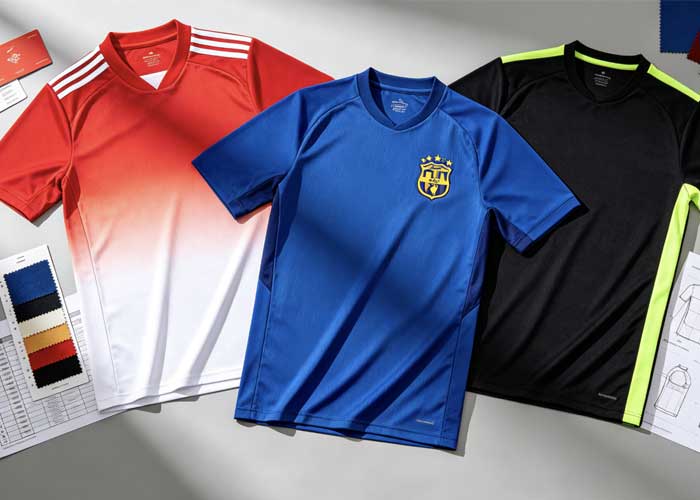
- Primary Color: This will be the dominant color of the jersey body. It should be bold and instantly associated with your team.
- Secondary Color: This color is used for contrast and detail, appearing on sleeves, side panels, or collars. It should complement the primary color.
- Accent Color: Used sparingly for high-impact details like trim, logos, or number outlines. A bright accent color can make a design pop.
When selecting colors, consider both aesthetics and practicality. Check your league’s regulations, as some have rules against certain color combinations to ensure visibility against opponents. Most importantly, ensure there is high contrast between the jersey color and the color of the names and numbers. A white number on a yellow jersey, for example, is nearly impossible to read from the stands or across the field.
Step 3: Place Your Logos
Logos, crests, and sponsor marks are the official seals of your jersey. Their placement is guided by tradition and regulations, but there is still room for creativity.
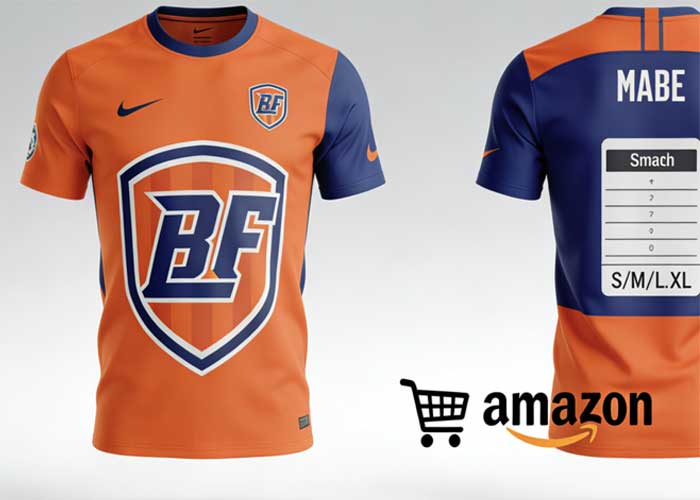
- Team Crest/Logo: The traditional placement is on the left chest, directly over the heart. This is the primary symbol of your team’s identity.
- Sponsor Logo: Typically placed on the center front of the jersey. If you have multiple sponsors, they may be placed on the sleeves or the back.
- League/Conference Patch: Often placed on one of the sleeves.
For the best possible quality, all logos must be provided in a vector file format. Vector files (with extensions like .AI, .EPS, or .SVG) are made of mathematical equations, not pixels. This means they can be scaled to any size—from a small sleeve patch to a large chest logo—without losing any sharpness or quality. A pixelated logo (like a .JPG or .PNG) will look blurry and unprofessional when printed on fabric.
Step 4: Choose Your Typography
The font you choose for player names and numbers—the typography—has a huge impact on the overall feel of the jersey.
- Readability is most important. The primary function of names and numbers is identification. Classic, bold, block-style fonts are popular for a reason: they are clear and easy to read from a distance.
- Style should match your concept. While block fonts are traditional, modern sans-serif fonts can offer a sleeker, more athletic look. Serif fonts (with small feet on the letters) can lend a classic, almost collegiate feel.
- Consistency is key. Use the same font family for both names and numbers to maintain a cohesive look. You can use variations (like a bold weight for numbers and a regular weight for names) for a subtle hierarchy.
Step 5: Use Online Design Tools
Most modern jersey suppliers, including us, offer powerful online 3D design tools. These platforms are your virtual workshop, allowing you to see your ideas in real-time.
- Experiment Freely: Use the designer to test different color combinations, font styles, and logo placements without commitment.
- View from All Angles: The 3D view is crucial. Rotate the model to see how the design flows from the front to the back and how elements on the sleeves look.
- Save and Share: Save different versions of your design and share the mockups with your team for feedback. This collaborative approach ensures everyone feels invested in the final product.
These tools bridge the gap between imagination and reality, helping you finalize a design with confidence before placing your order.
Choosing the Right Fabric

The look of a jersey is what catches the eye, but the fabric is what determines its performance, comfort, and longevity. The days of heavy, sweat-soaked cotton uniforms are long gone. Today’s custom football jerseys are engineered with advanced technical materials designed to help athletes perform at their peak. Understanding the key properties of these fabrics is essential to making the right choice for your team’s needs and budget. A key metric to understand is GSM (Grams per Square Meter), which indicates the weight and density of the fabric. A higher GSM generally means a more durable but potentially heavier material.
Common Jersey Fabrics
The vast majority of modern football jerseys are made from polyester or polyester blends, but not all polyester is created equal. Different weaves, weights, and treatments result in fabrics with distinct characteristics.
- Polyester Blends: This is the industry standard for a reason. Polyester is incredibly durable, resistant to shrinking and stretching, and holds color exceptionally well (colorfast). Most importantly, it is hydrophobic, meaning it does not absorb moisture. Instead, it wicks sweat away from the skin to the fabric’s surface, where it can evaporate, keeping players dry and comfortable.
- Mesh Panels: To enhance breathability, many jerseys incorporate mesh panels. These are typically placed in high-heat zones like the underarms, sides, and back. The open-weave structure of the mesh allows for maximum airflow, helping to regulate body temperature during intense play.
- Stretch Fabrics: For teams preferring a tighter, more athletic fit, fabrics blended with a small percentage of spandex (also known as elastane or Lycra) are ideal. This gives the jersey four-way stretch, allowing it to move with the body without restricting motion. This is common in elite-level jerseys where a snug fit can prevent opponents from grabbing onto the uniform.
Fabric Comparison Table
To simplify your decision, we’ve compared the most common fabric options. Use this table to match your team’s specific requirements with the best material.
| Fabric Type | Key Properties | Best For | Cost Level |
| Standard Polyester | Durable, good color retention, basic moisture-wicking. | Amateur leagues, practice jerseys, budget-conscious teams. | $ |
| Performance Polyester | Excellent moisture-wicking, lightweight, breathable, anti-odor. | Competitive play, frequent use, hot climates. | $$ |
| Stretch-Woven Polyester | 4-way stretch, durable, premium feel, athletic fit. | Professional teams, elite-level play, form-fitting designs. | $$$ |
| Polyester with Mesh | Zoned ventilation, enhanced airflow, lightweight. | All levels of play, especially for players who overheat. | $$ |
Printing Techniques Explained
Once your design is finalized and your fabric is chosen, the next step is to apply the graphics to the jersey. The printing method you select will affect the final look, feel, durability, and cost of your custom football jerseys. There are three primary techniques used in the industry today, each with its own set of strengths and ideal applications. Understanding the difference between them is crucial for ensuring your design vision is executed perfectly.
Sublimation Printing
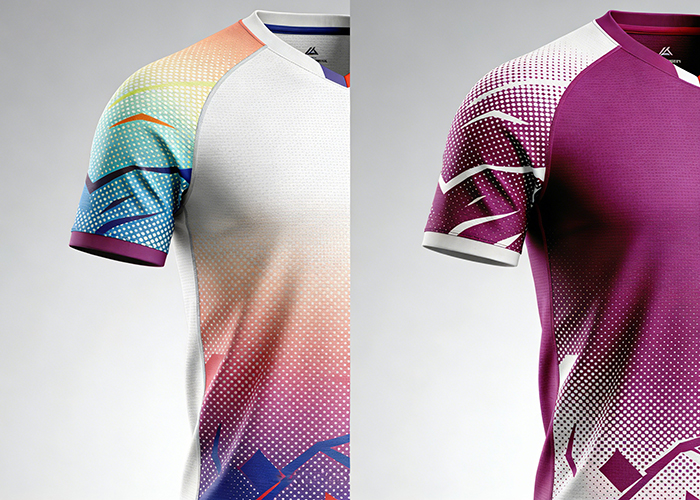
Sublimation is a state-of-the-art digital printing process that has revolutionized custom sportswear. Instead of applying ink on top of the fabric, sublimation uses heat to turn solid ink directly into a gas. This gas then penetrates the polyester fibers of the jersey, and as it cools, it solidifies and becomes a permanent part of the fabric itself.
- Pros: The design possibilities are limitless. You can use unlimited colors, gradients, patterns, and even photographic images across the entire garment. Since the ink is part of the fabric, the jersey remains perfectly lightweight and breathable. The design will never crack, peel, or fade, no matter how many times it’s washed.
- Cons: Sublimation only works on 100% polyester fabrics and is most effective on white or very light-colored base materials.
Screen Printing
Screen printing is a traditional and time-tested method. It works like a highly sophisticated stencil. A mesh screen is created for each color in your design. Ink is then pushed through the screen onto the fabric, one color at a time.
- Pros: For simple designs with one to three solid colors, screen printing is extremely cost-effective, especially for large batch orders. It produces vibrant, bold colors with a classic, slightly raised feel.
- Cons: The process becomes complex and expensive as you add more colors, as each one requires a separate screen. The layer of ink sits on top of the fabric, which can feel slightly heavy and may reduce breathability in the printed area. Over time and with many washes, screen-printed designs can crack or fade.
Heat Transfer Vinyl (HTV)
Heat transfer, often called heat press or iron-on, involves cutting designs, names, and numbers from a special sheet of vinyl (HTV). These cutouts are then positioned on the jersey and applied using a commercial heat press, which uses a combination of high temperature and pressure to bond the vinyl to the fabric.
- Pros: HTV is perfect for adding individual player names and numbers to pre-made jerseys. It creates crisp, sharp edges and offers a smooth, almost plastic-like finish. It’s also great for small orders or single-item customizations.
- Cons: The vinyl creates a non-breathable layer on the fabric. While modern HTV is more durable than in the past, it is still more prone to peeling or cracking over time than sublimation, especially if not cared for properly. It is not ideal for large, complex logos.
Printing Method Comparison Table
This table provides a head-to-head comparison to help you choose the best technique for your specific custom football jersey project.
| Technique | Feel on Fabric | Durability | Design Complexity | Best For |
| Sublimation | No feel (part of fabric) | Excellent (Permanent) | Unlimited colors, full-garment designs | Complex, vibrant designs; pro-quality look |
| Screen Printing | Slightly raised layer | Good | Best for 1-3 solid colors | Large orders with simple logos (e.g., events) |
| Heat Transfer | Smooth plastic layer | Moderate (can peel over time) | Excellent for sharp text/numbers | Individual names, numbers, small logos |
Diverse Industry Applications
While the football pitch is their natural habitat, the use of custom jerseys extends far beyond traditional sports. Their power as a tool for branding, unity, and identity has been embraced by a wide range of industries and organizations. Recognizing these applications can inspire new ways to leverage custom apparel for your own goals.
Scholastic and Collegiate Sports

For schools and universities, custom football jerseys are a cornerstone of athletic identity. They are steeped in tradition and are a powerful symbol of school pride. Durability is a key consideration here, as uniforms often need to last through multiple seasons of rigorous use, handed down from one year’s team to the next. The jersey represents the institution’s legacy, connecting current players with all those who have worn the same colors before them.
Corporate Leagues and Team Building
In the corporate world, custom jerseys serve a dual purpose. For inter-company sports leagues, they provide a professional look that reflects well on the company brand. More importantly, they are a powerful tool for team building. Outfitting employees in a shared uniform for a company event, volunteer day, or sports team breaks down departmental barriers and fosters a sense of camaraderie and shared purpose that translates back to the workplace.
E-Sports and Gaming Clans
The explosive growth of e-sports has seen gaming teams adopt the professional model of traditional sports, and custom jerseys are a central part of this. For a gaming clan, a jersey legitimizes their status as a competitive team. It helps build a recognizable brand, attracts sponsors, and creates a tangible product for a growing fan base to purchase and wear, solidifying the connection between players and their online community.
Charity Events and Fundraisers
Non-profits and community organizations use custom jerseys to great effect during charity runs, fundraising tournaments, and awareness campaigns. They help to easily identify event staff and volunteers in a crowd. More strategically, special edition jerseys can be sold or auctioned off to raise significant funds for a cause, transforming a piece of apparel into a vehicle for social good and a lasting memento for supporters.
The Future of Custom Jerseys
The world of custom sportswear is in a constant state of evolution, driven by technological innovation and shifting consumer values. As experts in the field, we are always looking ahead to what’s next. Staying aware of these trends not only keeps your team looking current but also opens up new possibilities for performance and personalization. Here are three key trends shaping the future of custom football jerseys.
Sustainability in Sportswear
The single biggest shift in the apparel industry is the move towards sustainability. There is a growing demand for eco-friendly products, and sportswear is no exception. We are seeing a significant rise in the use of recycled polyester, often made from post-consumer plastic bottles. These fabrics offer performance properties identical to virgin polyester but with a drastically reduced environmental footprint. Expect to see more manufacturers highlighting their use of recycled materials and water-saving dyeing processes as a key selling point.
Smart Jerseys and Wearable Tech
The jersey of the future will do more than just look good—it will provide data. We are on the verge of “smart jerseys” becoming more accessible. This involves integrating lightweight, washable technology directly into the fabric. Tiny GPS trackers can map a player’s movement and distance covered on the field, while biometric sensors can monitor heart rate, respiration, and muscle exertion in real-time. This data, once the exclusive domain of elite professional clubs, will become a vital tool for amateur coaches to analyze performance and prevent injury.
Hyper-Personalization and On-Demand
The traditional model of large-batch orders is being challenged by advancements in digital printing and on-demand manufacturing. The future is hyper-personalization. This trend moves beyond just adding a name and number. Imagine fans being able to order a jersey with a custom colorway, select from a library of patterns, or even add a personalized message that is sublimated directly into the fabric at the time of order. This allows for unparalleled individual expression and eliminates the need for suppliers to hold large, risky inventories.
Finalizing Your Order
You’ve perfected your design, chosen your fabric, and selected a printing method. The final stage is to place your order, and this is where attention to detail is absolutely critical. Small mistakes at this stage can lead to costly and frustrating delays. By following a structured process and double-checking everything, you can ensure a smooth and successful delivery.
Nailing the Sizing
Incorrect sizing is the single most common and preventable issue when ordering custom football jerseys. Do not guess sizes or assume a player’s “usual” size will match the supplier’s cut.
- Use the Chart: Every supplier has a specific size chart. Get a soft measuring tape and measure a few key players’ chests according to the chart’s instructions.
- Order a Sample Set: For large or high-stakes orders, we strongly recommend ordering a sizing sample set. This is a run of blank jerseys in various sizes. Allowing players to physically try them on is the only foolproof way to guarantee a perfect fit for everyone on the team. It’s a small upfront investment that can save you a massive headache later.
The Pre-Order Checklist
Before you click “submit” or send that final approval email, run through this checklist. Taking ten minutes to verify these details can save you weeks of waiting for a corrected order. We use this exact process internally to ensure accuracy.
| Item to Check | Confirmation (✔) |
| Final design proof approved by team/manager. | |
| Spelling of all player names is correct. | |
| Assignment of numbers to players is correct. | |
| Sizing list is based on measurements, not guesses. | |
| All logo files are in high-resolution vector format. | |
| Final cost, including shipping and taxes, is understood. | |
| Estimated delivery date meets your deadline. |
Frequently Asked Questions
We’ve guided hundreds of teams through this process, and a few questions come up time and time again. Here are quick, direct answers to some of the most common queries about ordering custom football jerseys.
What is the minimum order quantity?
This varies significantly based on the supplier and the printing method. For sublimation, which is a digital process, it’s often possible to order a single jersey, making it ideal for individuals or small teams. For screen printing, which requires creating physical screens for each color, there is almost always a minimum order quantity (MOQ), typically ranging from 12 to 24 pieces to make the setup costs worthwhile.
How long does it take to get them?
A safe estimate for the entire process—from design finalization to delivery—is typically between 3 to 6 weeks. This timeline can be affected by several factors. The complexity of your design, the size of your order, the printing technique chosen, and the time of year (peak season before sports seasons start is busier) all play a role. Always confirm the estimated delivery date with your supplier to ensure it aligns with your team’s needs.
Can I replicate a famous team’s jersey?
While you can be inspired by professional designs, you cannot create an identical copy of a professional team’s jersey. Team names, logos, and specific design elements are protected by copyright and trademark laws. Attempting to replicate them is illegal. However, you are free to create a jersey in a similar style, using your own team’s colors, logos, and branding. This is a great way to achieve a professional look while respecting intellectual property.
How should I wash my custom jerseys?
To ensure your custom jerseys last as long as possible and the customizations remain vibrant, proper care is essential. We recommend a simple routine: turn the jersey inside out before washing to protect logos and numbers. Wash in cold water on a gentle cycle. Most importantly, hang the jersey to air dry. High heat from a machine dryer is the number one enemy of custom applications like heat transfer vinyl and can damage the fabric over time. Avoid using bleach and fabric softeners.
Conclusion
A custom football jersey is far more than a uniform. It is a fusion of identity, technology, and art. It is the visual heartbeat of your team, a symbol of unity that resonates with players, coaches, and fans alike. Creating the perfect jersey is a journey—one that blends thoughtful design, an informed choice of materials, and a precise production process.
By following this guide, you have navigated the crucial steps: you have learned to build a design from a core concept, to understand the science behind performance fabrics, to choose the right printing technique for your vision, and to manage the final logistical details of your order. You are now equipped with the knowledge of an industry insider. Go forward and create a jersey that your team will wear with pride, a jersey that tells your story, and a jersey that will be remembered long after the final whistle blows.