Order a custom soccer jersey and the decisions are simple: one lightweight fabric, one athletic cut, one printing method. Order a custom jersey for a contact sport and everything multiplies. American football and rugby jerseys are not decorated T-shirts — they are pieces of sports equipment that get grabbed, dragged, stretched, and machine-washed 40 times a season.
That difference catches buyers off guard. As a sportswear factory with 17+ years of OEM experience producing contact-sport uniforms for teams in North America, Europe, and Australia, we see the same mistakes repeat: a club specs a 150 GSM soccer-weight fabric for a rugby forward pack, or a youth football program pays for screen-printed numbers that crack by week six.
This guide explains the three decisions that determine whether your custom football or rugby jerseys survive the season — fabric, cut, and decoration — with the production data behind each one.
Quick Answer: What Makes Football and Rugby Jerseys Different?
For buyers who need the short version:
- Fabric weight. Soccer jerseys run 140–160 GSM. American football jerseys combine a ~220 GSM mesh body with a dazzle yoke up to 320 GSM. Rugby jerseys use dense 260–350 GSM knits. Contact sports need roughly double the fabric weight of non-contact sports.
- Cut. American football jerseys are engineered to fit over shoulder pads, with elastic cuffs and shorter bodies. Rugby jerseys are cut skin-tight with no pad allowance, because a loose jersey is a handle for the opponent.
- Decoration. American football’s signature look is tackle twill — layered, sewn-on numbers. Rugby’s standard is full sublimation, because sewn layers would chafe and rip in scrums.
The sections below explain why, and how to spec each correctly.
The Market Context: Why Contact-Sport Jerseys Are a Growth Category
Two datasets tell the story.
Rugby first. According to Fortune Business Insights, the global rugby apparel market was valued at $1.43 billion in 2025, is estimated at $1.61 billion in 2026, and is projected to reach $4.36 billion by 2034 — a compound annual growth rate of 13.21 percent, one of the fastest in team sports. World Rugby reported that participation grew 11 percent in 2023 alone, reaching 8.46 million registered players across 132 nations, with women and girls driving much of that growth. Jerseys account for 42.3 percent of the rugby apparel product mix, per Market.us analysis.
American football’s numbers are anchored in the school system. The NFHS reports roughly one million high school football participants in the United States each year, feeding a uniform replacement cycle that never stops. The structural growth story, though, is flag football: non-contact formats are expanding rapidly in youth programs and schools, and flag football will make its Olympic debut at the Los Angeles 2028 Games. Flag football jerseys follow rugby logic — tight cut, no pads, sublimation-friendly — which is pulling rugby-style construction into the American market.
For brands and retailers, the implication is direct: contact-sport jerseys are a premium-priced, specification-driven category where buyers actively search for manufacturing detail. That is the audience this guide serves.
Terminology First: Which “Football” Are We Talking About?
Search data shows buyers use “football jersey” for three different products, so let us define the scope of this guide:
- American football — gridiron, played with helmets and shoulder pads. Jerseys fit over equipment.
- Rugby — union, league, and sevens. No pads, full contact, jerseys must survive grabbing and scrummaging.
- Flag football — the non-contact variant growing fastest in North America, structurally similar to rugby jerseys.
(Soccer — “football” everywhere outside North America — runs on lighter 140–160 GSM construction; we covered it in our 2026 World Cup jersey design analysis.)
Part 1: Fabrics — GSM Is the Number That Decides Everything
GSM (grams per square meter) measures fabric density, and in contact sports it is the single best predictor of whether a jersey lasts one season or three.
American football fabrics: a two-fabric system
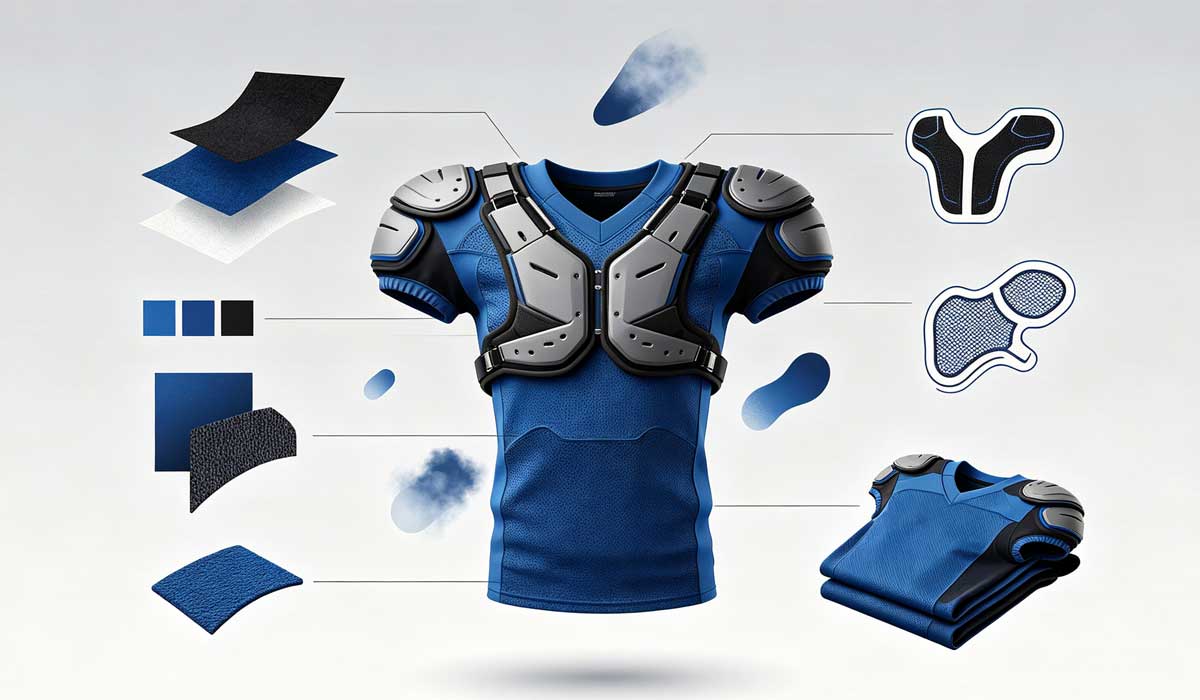
A modern American football jersey is not one fabric — it is an engineered assembly:
| Component | Fabric | Typical weight | Function |
|---|---|---|---|
| Body (front/back) | Porthole mesh or pro mesh polyester | 200–220 GSM | Ventilation under pads, durability |
| Shoulder yoke | Dazzle (tricot) polyester | 280–320 GSM | High-sheen pro look, abrasion resistance where pads rub |
| Side panels / gussets | Polyester-spandex stretch mesh | 180–220 GSM | Mobility, snug fit over pads |
| Cuffs | Heavy elastic rib knit | — | Keeps sleeves tight so opponents cannot grab |
Dazzle fabric deserves a note because buyers ask about it constantly. It is a tricot-knit polyester with a lustrous, almost satin face — the signature shine of American football shoulders. The sheen comes from the knit structure, not a coating, so it does not wash off. Its trade-off: dazzle snags more easily than plain knits, which is why it lives on the yoke and shoulders rather than the full body.
Porthole mesh — the body fabric with the distinctive large holes — exists because players wear hard plastic pads underneath. Airflow through the jersey body is the only ventilation path the uniform has.
Rugby fabrics: dense, tight, and built to be grabbed
Rugby jerseys use a completely different construction logic:
- Dense polyester or polyester-elastane knits at 260–350 GSM. The fabric must resist a defender’s full grip without tearing or permanently stretching out. Elastane content (typically 8–15 percent) lets the jersey stretch and recover instead of ripping.
- Smooth face, no open mesh on the torso. Open porthole mesh would give opponents finger-holds. Ventilation zones, when used, sit in small panels at the upper back where grabbing is rare.
- Reinforced collar and placket. Traditional rugby collars (button placket or modern banded collar) take direct pulling force; the collar attachment is the most common failure point in cheap rugby jerseys.
The weight comparison, visualized
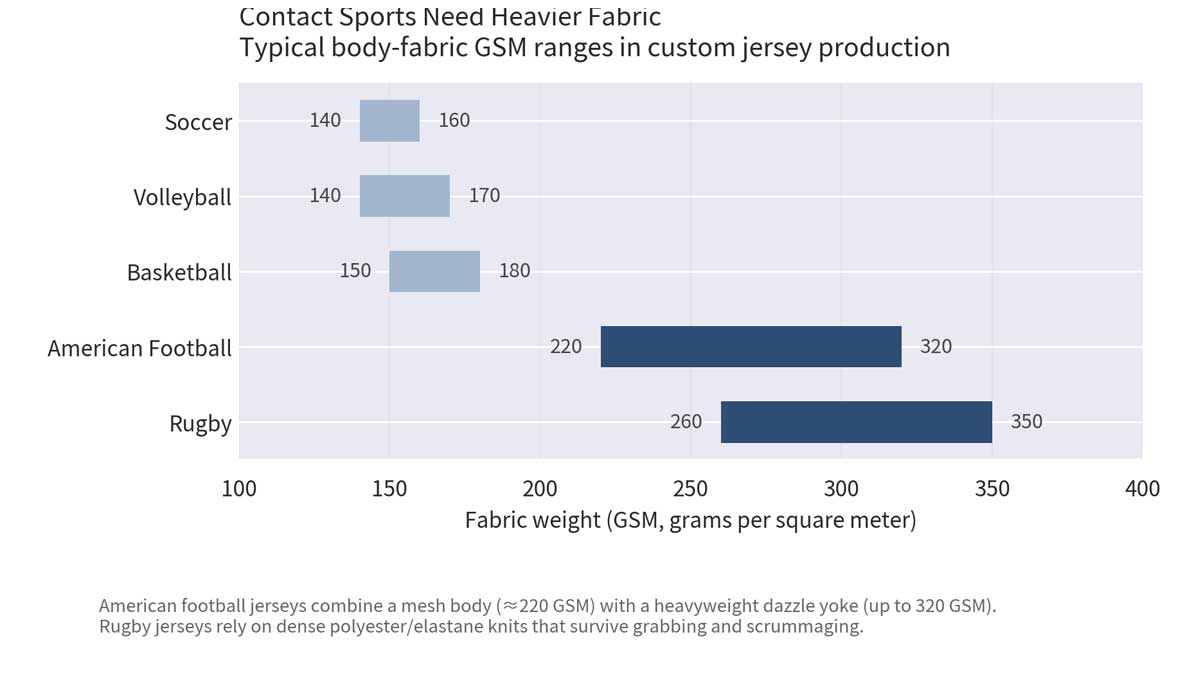
The pattern in the chart is the pattern in our warranty data: jerseys returned with torn bodies almost always trace back to a fabric specced below the contact-sport threshold. A 160 GSM body in a rugby match is not a cost saving — it is a reprint waiting to happen.
Performance specs worth writing into your purchase order
Beyond GSM, three testable specifications separate professional-grade contact jerseys from commodity ones:
- Bursting strength (ISO 13938): the key metric for grabbed fabric. Ask your manufacturer for the test value on the actual fabric lot.
- Abrasion resistance (Martindale method): critical for American football yokes that rub against pad plastic every play.
- Color fastness to washing (ISO 105-C06): contact-sport jerseys get washed hot and often. Specify grade 4.0 or higher.
Any factory that cannot quote these three numbers for your fabric is guessing.
Part 2: Cuts — One Sport Fits Over Armor, the Other Fits Like Skin
American football cuts: engineered around pads
An American football jersey has to solve a geometry problem: fit over 2–3 inches of shoulder pad plastic without looking like a poncho. The standard solutions:
- Skill-position cut (quarterbacks, receivers, defensive backs): tapered body, spandex side panels, elastic cuffs, body length ending at the belt line. A loose jersey is a tackling handle, so modern skill cuts are aggressively snug below the pads.
- Lineman cut: roomier through the chest and arms for larger pad shells, heavier cuff elastic, often with an extended back hem (“drop tail”) to stay tucked during contact.
- Youth and flag cuts: same visual language without the pad allowance — lighter mesh, standard athletic body, shorter sleeves.
Practical spec note most buyers miss: order your samples over the actual pads your team uses. Pad shells vary by brand and position, and a jersey graded for a skill-position pad will bind across a lineman shell. Reputable factories will ask for your pad brand or a physical pad to pattern against.
Rugby cuts: the anti-grab silhouette
Rugby’s cut philosophy is the opposite of every casual garment: nothing loose, anywhere.
- Slim/athletic fit through the entire body. Modern rugby jerseys fit like a second skin because fabric slack is what defenders grab. A well-cut rugby jersey should feel almost too snug when first pulled on.
- Raglan or set-in sleeves with gusseted underarms for binding in the scrum — the range of motion demand is upward and forward, unlike most sports.
- Longer back hem with silicone gripper tape at the waistband on premium models, keeping the jersey tucked through rucks and mauls.
- Variant differences: Rugby union jerseys keep the traditional collar; rugby league runs leaner; sevens prioritizes lightweight speed and often uses the lightest GSM in the rugby range.
Sizing for both sports: contact-sport rosters span extreme body types — a rugby squad runs from a 60 kg scrum-half to a 120 kg prop, and a football roster from a slot receiver to a 140 kg nose tackle. Insist on a graded size set (at minimum S, L, and 3XL samples) before bulk production. Fit failure at the size extremes is the number-one cause of team-order disputes we see.
Part 3: Decoration — Tackle Twill vs. Sublimation vs. Everything Else
Decoration is where American football and rugby diverge most sharply, and where the most money is wasted.
Tackle twill: the American football standard
Tackle twill (also called sewn twill or appliqué) is the method behind the classic pro football look: numbers and names cut from polyester twill fabric, layered one or two colors deep, and stitched directly onto the jersey with a dense zigzag or satin-stitch border.
Why it dominates American football:
- Durability under violence. Sewn twill has no ink to crack. A properly stitched twill number outlasts the jersey body itself — this is why vintage football jerseys from the 1990s still have intact numbers.
- The authentic look. Retail “authentic” NFL jerseys use tackle twill; it carries a premium perception that printed numbers cannot match. For high school programs, colleges, and semi-pro teams selling replica jerseys to fans, twill is what makes the replica feel real.
- Repairability. A torn twill number can be unstitched and replaced. A cracked print cannot.
The trade-offs: tackle twill adds labor cost per unit (each number is cut, positioned, and sewn), it adds weight, and it is unsuitable for all-over graphic designs. It also requires reinforcement stitching at stress points — cheap twill jobs fail at the stitch line, not the twill.
Sublimation: the rugby standard
Full dye sublimation infuses design into the polyester fibers at around 200°C, making the print a permanent part of the fabric. Rugby adopted it as the default for reasons that are structural, not aesthetic:
- Nothing to grab. Sewn twill layers and heat-pressed vinyl create edges and thickness — exactly what an opponent’s fingers need. Sublimation leaves the fabric surface perfectly smooth.
- No chafing in the scrum. Stitched appliqué on the torso would grind against skin and other bodies for 80 minutes.
- Unlimited design at zero price penalty. Hoops, gradients, sponsor logos, heritage patterns — sublimation prices by fabric and labor, not by color count or coverage. This is why rugby kits are visually the most adventurous in contact sports.
The full comparison
| Method | Durability in contact play | Cost profile | Design freedom | Best for |
|---|---|---|---|---|
| Tackle twill (sewn) | Excellent — outlasts garment | Highest per unit; labor-driven | Numbers, names, logos only | American football game jerseys, premium replicas |
| Sublimation | Excellent — print is in the fiber | Flat per unit; complexity-free | Unlimited: all-over art, gradients, photos | Rugby, flag football, practice jerseys, fan wear |
| Screen printing | Poor–fair — cracks under stretch and washing | Low at volume; per-color setup | Simple spot-color graphics | Training tees, camp shirts — not game jerseys |
| Heat transfer vinyl | Poor — peels under grabbing and hot washes | Low for small runs | Names/numbers on light garments | Youth flag football, one-off personalization |
| Embroidery | Excellent | High for large designs | Logos and crests only | Polo-style rugby leisurewear, staff apparel |
A practical hybrid we produce often: sublimated body with sewn twill numbers for American football teams that want custom graphics plus the authentic twill look. It costs more than either method alone, but for programs selling replicas to their community, the retail margin covers it.
Construction Details That Decide Whether Jerseys Survive
Fabric, cut, and decoration get the attention, but seam engineering is where cheap jerseys actually fail. What to look for:
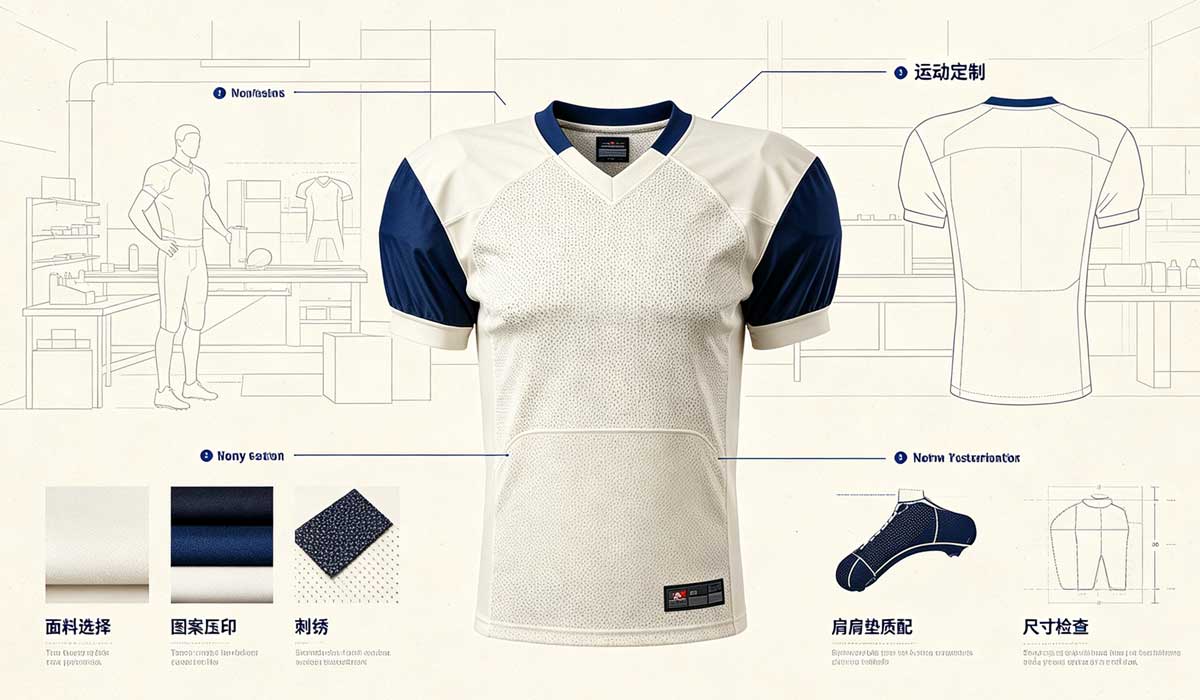
- Bar-tack reinforcement at every stress point: collar attachment, sleeve joins, side-seam ends, and the base of the placket. A bar-tack is a dense cluster of stitches that stops seam failure from propagating. Count them on a sample — premium rugby jerseys carry 8–12.
- Flatlock or coverstitch seams on body joins. Overlocked seams are cheaper but create raised ridges that chafe under pads and in scrums; flatlock lies flush against the skin.
- Twin-needle hems with stretch thread, so the hem stretches with the fabric instead of popping.
- Spiral-knit or reinforced cuffs on football jerseys — cuff elastic failure is the most common wear complaint after number damage.
Ask any manufacturer to walk you through these four points on a physical sample. The answer tells you more about the factory than any certificate on their website.
How to Spec Your Order: A Buyer’s Checklist
Whether you are a high school program ordering 40 football jerseys or a brand launching a rugby line, this is the brief that gets you an accurate quote and a correct product:
- Sport and format — American football (tackle or flag), rugby (union, league, or sevens). This determines the base pattern.
- Fabric spec in writing — GSM per garment zone, elastane percentage, and any certification requirements (GRS for recycled content, OEKO-TEX for substance safety).
- Cut references — pad brand for football; fit photos for rugby. Better still, send a jersey your team currently likes.
- Decoration map — which elements are twill, which are sublimated, placement of sponsors, and number sizes in inches (front, back, TV numbers on sleeves or shoulders).
- Size set approval — minimum three graded samples across your roster’s extremes before bulk.
- Timeline honesty — sampling runs about one week; bulk production two to four weeks depending on decoration complexity. Twill adds time. Season-start deadlines in August and September are the industry’s congestion point — order early.
Three Costly Mistakes We See in Contact-Sport Jersey Orders
After 17 years of producing contact-sport uniforms, three ordering errors account for most of the disappointment we help new clients recover from.
Mistake 1: Choosing fabric by photo instead of by weight. Two jerseys can look identical in a product image and differ by 100 GSM. Buyers comparing quotes on visuals alone end up with soccer-weight fabric in a contact sport. The fix is mechanical: always compare quotes at equal GSM, and request a physical swatch card before committing. Fabric hand-feel is a five-second test that prevents a five-figure mistake.
Mistake 2: Approving the design before approving the construction. Teams spend weeks perfecting a crest and approve production without a single question about bar-tacks, seam type, or cuff elastic. Eight weeks later the jerseys look great and rip at the collar. The correct sequence is construction sample first, design proof second, bulk third.
Mistake 3: Buying for the average player. A roster is not an average. Programs that order a single “team fit” discover in week one that the props cannot raise their arms and the slot receivers are wearing tents. Grade across extremes, and for American football, split the order into skill and lineman cuts — most factories, including ours, can run two cuts in one order at minimal extra cost.
Each of these mistakes is cheaper to prevent than to fix, and all three are visible in a physical sample. That is why we treat the sampling stage as the most important week of any contact-sport order.
Frequently Asked Questions
What fabric is best for custom American football jerseys?
A two-fabric system: 200–220 GSM porthole or pro mesh polyester for the body, with a 280–320 GSM dazzle tricot yoke across the shoulders, plus spandex-blend side panels for fit over pads. This combination mirrors what professional and top college programs wear.
What fabric is best for custom rugby jerseys?
Dense 260–350 GSM polyester-elastane knit with 8–15 percent elastane. The weight resists tearing under grabbing, and the elastane lets the fabric stretch and recover instead of ripping. Avoid open mesh on the torso — it gives opponents finger-holds.
What is tackle twill and why do football jerseys use it?
Tackle twill is decoration made from layers of polyester twill fabric cut into numbers and letters, then sewn onto the jersey with dense border stitching. It is the American football standard because it has no ink to crack, survives violent contact and hot washing, and delivers the authentic professional look that printed numbers cannot match.
Is sublimation or tackle twill better for rugby jerseys?
Sublimation, almost always. Rugby jerseys must have a perfectly smooth surface — sewn twill layers create grab points for opponents and chafe in scrums. Sublimation also allows unlimited all-over design at no extra cost, which is why rugby kits feature the boldest graphics in contact sports.
How much do custom football jerseys cost compared to soccer jerseys?
Contact-sport jerseys typically cost 30–60 percent more per unit than soccer jerseys because of heavier fabric (roughly double the GSM), more complex multi-fabric construction, and — for American football — tackle twill labor. A realistic factory-direct range is $15–35 for sublimated rugby/flag jerseys and $25–50 for tackle-twill football jerseys, depending on quantity and decoration.
Can American football jerseys be sublimated instead of using twill?
Yes, and many programs now choose it. Sublimated football jerseys cost less, weigh less, and allow all-over designs. The trade-off is aesthetic: sublimation cannot replicate the dimensional, stitched look of twill that fans associate with authentic pro jerseys. Programs selling replicas to fans usually keep twill; teams prioritizing budget and design freedom go sublimated.
How should a football jersey fit over pads?
Snug below the pads, never loose. Skill-position cuts taper through the body with elastic cuffs ending at the belt line; lineman cuts allow more room for larger pad shells. Always sample against the actual pad brand your team wears — pad geometry varies enough to change the required jersey grade.
What is the minimum order for custom football or rugby jerseys?
Factory-direct MOQs have collapsed with digital production. We accept single-piece samples and small team runs, with pricing breaks typically at 25, 50, and 100 pieces. Tackle twill carries higher per-unit labor at any quantity, so small twill orders cost proportionally more than small sublimated orders.
The Bottom Line
Custom football and rugby jerseys reward buyers who spec like equipment managers rather than T-shirt shoppers. Get the three decisions right — contact-grade fabric weight, a cut matched to pads or anti-grab fit, and decoration chosen for the sport’s physics — and a jersey will outlast the season and the one after it. Get them wrong and no discount saves you.
At Jistar Sport, we manufacture both systems every week: dazzle-and-mesh American football jerseys with sewn tackle twill, and dense-knit sublimated rugby jerseys with bar-tacked reinforcement — from single samples to 100,000-piece monthly capacity, with free design support. Send us your spec or even just a photo of a jersey you like, and we will return a free mockup, fabric recommendation, and quote.