The final whistle blew on the 2026 FIFA World Cup in July. If you think the jersey business ended with it, the data says you are about to miss the most profitable twelve months in soccer retail history.
Consider what happened during the tournament itself. Within the first two weeks, 28 percent of Nike’s World Cup merchandise had sold out, according to LSEG and Centric Market Intelligence — and Nike’s mid-July restock of the USMNT kit landed more than a week after the team was eliminated, launched with a 17 percent markdown that vanished from the site within days. Soccer.com told amNewYork that its peak exceeded expectations by 15 to 20 percent, with “almost 100 percent full price sell-out” — and that USMNT jerseys remained sold out even after elimination. A $175 Norway authentic jersey was reselling for more than $300 on GOAT.
That is not tournament demand. That is unmet demand walking around looking for a supplier.
This guide is for the retailers and Amazon sellers who intend to catch it: what the post-World-Cup demand curve actually looks like, which jersey styles to restock, how to calculate reorder quantities without betting the business, and the intellectual-property lines you cannot cross.
Quick Answer: How Should Retailers Restock Soccer Jerseys After the 2026 World Cup?
For sellers who need the playbook in one paragraph:
Restock in small, fast batches rather than one large seasonal buy. Prioritize national-team-inspired styles — heritage designs, retro waves, and country-color stories — because national team kits stay current until the next cycle in 2028. Keep 60–70 percent of volume on sea freight for margin and 30–40 percent available for air freight replenishment when a style spikes. Calculate reorder points from your actual daily sell-through, not gut feel. And build every design around generic football aesthetics and country colors, never FIFA trademarks or federation logos.
The rest of this article is the detail behind each of those sentences.
What the 2026 World Cup Actually Did to Jersey Demand
Three data points from the tournament should reshape how you plan the 2026–27 season.
1. Scarcity proved willingness to pay full price. Nike sold out of authentic jerseys for at least four of its sixteen sponsored federations — the United States, France, Brazil, and Norway — while Adidas stayed in stock and captured full-price sales, per reporting by Business Model Analyst on LSEG/Centric data. Neither brand resorted to discounting World Cup merchandise during the tournament. When the biggest sportswear companies on earth cannot keep jerseys on shelves at $125–175 retail, the consumer message is clear: price is not the objection; availability is.
2. Demand concentrated in team identity, not generic product. YipitData tracking of U.S. soccer apparel showed licensed Adidas products growing from 53 percent of category sales in January 2025 to 83 percent by March 2026 — while generic branded soccer apparel declined 22 percent year over year. When the 2026 home kits launched in November 2025, national teams’ share of licensed sales jumped from 2 percent to 57 percent in a single month. Buyers want a jersey that says something about who they are. Blank-looking product loses.
3. The winner had a cultural story, not just a flag. Mexico’s green home jersey was widely reported as the best-selling shirt of the tournament — 55 percent of Adidas’s U.S. national-team licensed sales over the trailing twelve months, growing 59 percent year over year (YipitData). Its design leaned into heritage motifs with genuine streetwear appeal. Jamaica’s Bob Marley-themed away shirt became the tournament’s sleeper fashion hit. Spain’s deep-red kit sold to people who wear it with jeans, not just to matches. The commercial lesson for private-label sellers: the money is in designs with cultural meaning and lifestyle crossover, and sublimation printing makes that design quality accessible at any order size.
The Post-World-Cup Demand Calendar: Four Selling Windows
World Cup demand does not die — it disperses into predictable windows. Here is how the next twelve months typically break down, and what drives each phase:
| Window | Timing | Demand driver | What sells |
|---|---|---|---|
| Club season kickoff | Aug–Oct 2026 | Domestic leagues restart; fans carry WC enthusiasm into club support; new 2026–27 club kits launch | Club-style kits, retro designs, supporter wear |
| Holiday retail | Nov–Dec 2026 | Gifting season; jerseys are a top sports gift | Youth sizes, giftable designs, bundled sets |
| Winter–spring trough | Jan–Mar 2027 | Lowest volume, but also lowest competition and cheapest ads | Evergreen national styles, training wear |
| Pre-season build | Apr–Jul 2027 | Summer tournaments, youth leagues, camp season | Team orders, custom club kits, youth bulk |
Two structural facts make this cycle unusually favorable for sellers:
- National team designs have a two-year shelf life. Federations do not refresh kits until the next cycle — Norway, the tournament’s breakout story, will not issue a new kit until 2028. A national-inspired design you stock today is not obsolete in June; it is current for roughly two more years.
- Every 24-hour spike is now a sales event. Soccer.com’s merchandising director noted that a big player performance produces five to ten times normal sales for several days. In the club season, those moments happen weekly — a Champions League hat-trick, a derby win, a transfer announcement. Sellers with fast replenishment win moments that sellers with slow supply chains only read about.
What to Restock: The Design DNA That Won 2026
Restocking is not about reordering what you had. It is about stocking what the tournament taught consumers to want. Five style directions carried the commercial momentum out of 2026:
- Heritage and cultural motifs. Mexico’s artisan-inspired detailing and Jamaica’s Marley tribute outsold safe designs. For private label, this means country-color stories with textured, sublimated cultural patterns — the design category with the highest margin and the least direct competition.
- Retro waves and 1994 nostalgia. The USMNT’s throwback wave stripe sparked club-level demand that has not slowed. Retro reads as intentional design, and it photographs well — which matters when your customers discover products on TikTok and Instagram.
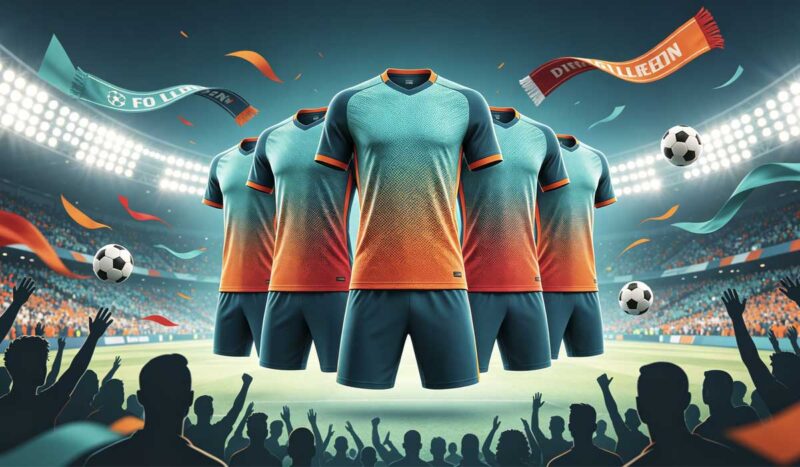
- Gradient color flows. Deep teals shifting to electric blue, charcoal opening to grey. Gradients were the most-requested custom pattern of the tournament cycle and cost nothing extra in sublimation.
- Fashion-crossover fits. Spain and France proved a jersey is now streetwear. Relaxed cuts and lifestyle colorways extend your addressable market beyond match-day fans.
- Collector-angle designs. Germany’s 2026 shirt carries end-of-an-era value because the Adidas partnership ends before Nike takes over in 2027. Limited-run designs with a story (“final edition,” “anniversary”) create urgency without discounting.
For custom and private-label sellers, the practical move is translating these directions into original artwork: same design language, zero licensed IP. More on that line in the compliance section below.
The Replenishment Playbook: Quantities, Timing, and Freight
This is the section that decides whether the demand window makes you money or just makes you busy.
Rule 1: Test small, scale fast
The era of one big pre-season container is over. The sellers who profited most from World Cup merchandise used small-batch testing: launch 50–200 units of a style, read two weeks of sell-through data, then reorder winners aggressively. Factory MOQs of one piece for sampling and 25+ for production runs make this model possible — you are no longer forced to bet a season on a guess.
Rule 2: Calculate reorder points from data, not optimism
The working formula:
Reorder Point = (average daily sales × supplier lead time in days) + safety stock
A worked example for an Amazon FBA seller:
| Variable | Value | Notes |
|---|---|---|
| Average daily sales | 12 units/day | From 30-day sell-through |
| Production time | 14 days | Sublimated jerseys, confirmed design |
| Sea freight + FBA check-in | 35 days | China to U.S. FBA |
| Total lead time | 49 days | |
| Demand during lead time | 588 units | 12 × 49 |
| Safety stock | 180 units | ~15 days of buffer |
| Reorder point | 768 units | Reorder when FBA + inbound hits this level |
The most common failure mode is not the math — it is using the average when a style is accelerating. If a design is riding a viral or performance-driven spike, run the calculation on the last 7 days of sales, not the last 30.
Rule 3: Split your freight
Margin lives on the boat; opportunity lives on the plane. The proven structure:
- 60–70 percent of volume by sea for your validated sellers — the styles with 60+ days of stable sell-through.
- 30–40 percent reserved for air freight replenishment — smaller, faster injections when a style spikes or a selling window opens. Air freight adds roughly $1.50–3.00 per jersey depending on volume; on a $35–45 retail item with full-price demand, that is a margin haircut, not a margin killer.
- Use Amazon AWD or a 3PL as a buffer. Upstream bulk storage with automatic FBA replenishment smooths the gap between a 49-day sea lead time and Amazon’s restock limits. Inventory tools like SoStocked, Helium 10’s inventory module, or RestockPro can automate the reorder-point alerts.
Rule 4: Book production capacity before you need it
Factories fill their lines around predictable peaks: the August–September club season rush and the April–June pre-summer production window. A supplier who quotes two weeks in May may quote five in August. Lock in production slots — or at minimum confirmed fabric allocation — for your core styles ahead of each window.
The IP Compliance Line: Where Amazon Sellers Get Killed
This section is not legal advice, but it may save your seller account. World Cup demand tempts sellers into dangerous territory, and Amazon’s IP enforcement is automated and unforgiving.
Generally safe territory:
- Country colors and color-blocking (a green-white-red shirt is not infringement)
- Generic football graphics — balls, nets, trophies, stadium motifs
- Original heritage patterns inspired by cultural textiles
- Generic fan slogans without team or tournament references
- Your own brand’s original designs, however bold
Danger territory — expect takedowns:
- FIFA, World Cup, and tournament wordmarks and logos — all registered and actively enforced
- National federation crests and official kit designs (these are protected as trade dress and copyright)
- Player names and image rights
- “Official,” “licensed,” or implied affiliation language in listings
- Replica designs copied stitch-for-stitch from official kits
The commercial insight from the tournament actually points the same direction as the legal one: Mexico and Jamaica sold because of original cultural design, not because of the badge. Build original heritage designs and you are simultaneously more legal and more differentiated. When in doubt, have a design reviewed before production — a factory with real OEM experience will flag risky artwork, because customs seizures hurt them too.
Converting the Demand: Listing and Content Notes for Amazon Sellers
Traffic without conversion is expensive. Four listing upgrades matter specifically for post-World-Cup jersey buyers:
- Keyword realignment. Search behavior shifts after a tournament: “world cup jersey” cools while “[country] soccer jersey,” “retro soccer jersey,” and “soccer jersey men/women/youth” carry the volume. Rebuild titles and backend terms around country + style + recipient.
- A+ content that tells the design story. Heritage patterns and cultural motifs convert when the listing explains them. YipitData’s licensed-versus-generic data says identity is the purchase driver — your A+ modules are where a private-label brand builds it.
- Lifestyle imagery. Spain’s kit sold to people wearing it with jeans. Show the jersey off the pitch: streetwear styling, watch-party settings, youth training. Sublimated all-over designs photograph exceptionally well — use that.
- Review harvesting from the spike. If you sold through tournament demand, those buyers are your review base. Post-purchase review requests in the 30 days after a demand spike convert at the highest rate of the year.
Beyond Amazon: Where Post-World-Cup Demand Actually Sells
Amazon is the loudest channel, not the only one. Post-tournament jersey demand shows up in four places, and each rewards a slightly different play:
- Your own DTC site. Margin is best here, and the YipitData finding — that team-identity buyers shop across brands — means a compelling heritage design can pull customers who normally buy licensed product. Pair the jersey with the design story and an email capture; World Cup cohorts repurchase.
- TikTok Shop and social commerce. Retro waves and gradient designs are made for short video. A single well-performing organic clip can replicate a “player moment” spike for a private-label design — budget air-freight replenishment for exactly this scenario.
- Local team orders. Post-World-Cup years reliably produce a surge in youth sign-ups and new amateur clubs, and every new club needs 15–30 custom kits. Retailers who add a “custom teamwear” page capture order values ten times larger than single-shirt sales — and the factory relationship is identical.
- Marketplace long tail (eBay, Walmart, Etsy). Collector-angle and limited-run designs overperform here, where buyers actively hunt distinctive shirts rather than defaulting to the first search result.
The Five Numbers to Watch Every Week
Restock discipline is a weekly habit, not a quarterly review. These five metrics tell you everything:
- Sell-through rate by style — units sold ÷ units received, rolling 14 days. Above 60 percent: reorder now. Below 30 percent: stop replenishing and diagnose.
- Days of cover — current FBA plus inbound stock ÷ average daily sales. Below your 49-day lead time means you are already late.
- Conversion rate on jersey sessions — a traffic spike with flat conversion is a listing problem (images, price, reviews), not an inventory problem.
- Ad cost of sales (TACOS) — post-tournament clicks get cheaper in the January–March trough; that is when share of voice is cheapest to buy.
- Review velocity — new reviews per week is the leading indicator of organic rank momentum after a demand spike.
Your Supplier Checklist for the 2026–27 Season
Restock speed is a supplier property, not a logistics trick. Before the season, verify:
- MOQ flexibility — single-piece sampling and small production runs (25–100 units) for testing
- Confirmed production timelines — sampling around one week, bulk in two to four weeks, in writing
- Fabric allocation — 140–160 GSM sublimation-grade polyester held or quickly available for your orders
- Design support — free mockups within 24 hours so new styles launch in days, not weeks
- Repeat-order consistency — Pantone-anchored color matching so batch three matches batch one
- Certification documents — OEKO-TEX at minimum; GRS if you sell into sustainability-conscious channels
- IP awareness — a factory that proactively flags risky artwork is protecting your account
Frequently Asked Questions
Is soccer jersey demand still strong after the 2026 World Cup?
Yes. Retailers reported that demand outlasted the tournament itself — USMNT jerseys stayed sold out even after elimination, and national team kits remain current until federations refresh them for the 2028 cycle. Post-tournament demand disperses into the club season, holiday gifting, and the 2027 pre-season build rather than disappearing.
When is the best time to restock soccer jerseys after a World Cup?
Immediately, in small batches. The club season kickoff (August–October) and holiday retail (November–December) are the two largest post-tournament windows. Sellers who wait for “next season” miss both, because sea-freight lead times of five to seven weeks mean a September decision arrives in November.
How many jerseys should I reorder at once?
Calculate from sell-through: multiply average daily sales by total supplier lead time (production plus shipping plus FBA check-in), then add roughly two weeks of safety stock. Test new styles at 50–200 units; scale only designs with proven two-week sell-through above 60 percent.
Can I sell World Cup-themed jerseys on Amazon without a license?
You can sell soccer jerseys with country colors, generic football graphics, and original designs. You cannot use FIFA or World Cup trademarks, federation crests, official kit designs, or player names — these trigger automated takedowns and potential account suspension. Original heritage-inspired designs are both safer and, as the 2026 tournament proved, commercially stronger.
What jersey styles sold best during the 2026 World Cup?
Culturally rooted designs led: Mexico’s heritage green home shirt was the tournament’s best-seller, Jamaica’s Marley-themed away kit was the fashion breakout, and retro designs like the USMNT’s 1994-inspired wave stripe drove sustained demand. The pattern: cultural story plus lifestyle wearability beats plain designs.
How do I handle restocking when a jersey suddenly goes viral?
Run reorder math on the last 7 days of sales, not 30. Place an immediate air-freight order covering two to three weeks of spiked demand while a larger sea-freight order follows. Spikes from player performances typically sustain five to ten times normal sales for several days — speed of response matters more than order size.
Should I discount leftover World Cup inventory?
Rarely. Tournament data showed full-price sell-outs across major retailers, and national team designs remain relevant for roughly two years. Discounting trains customers to wait and erodes the premium positioning that heritage designs command. If a style is truly dead, bundle it as a gift-with-purchase rather than marking it down.
What MOQ should I expect from a custom jersey factory?
Modern sublimation factories accept single-piece samples and small production runs starting around 25 pieces, with price breaks at 100, 500, and 1,000. Any supplier demanding large minimums for a restock-tested design is structurally misaligned with the small-batch replenishment model that post-2026 retail requires.
The Bottom Line
The 2026 World Cup did not create a jersey moment; it created a jersey market. Full-price sell-outs, two-year design shelf life, weekly club-season demand spikes, and a consumer trained to want cultural storytelling in their sportswear — all of it is still running, and most of your competitors are waiting for “next summer.”
The sellers who win the 2026–27 season will test small, restock fast, split their freight, stay legally clean, and stock designs with a story. None of that requires a big budget. It requires a fast factory.
At Jistar Sport, we produce custom sublimated soccer jerseys with single-piece sampling, small-batch production from 25 pieces, free 24-hour design mockups, and 17+ years of OEM experience shipping to Amazon sellers and retailers worldwide. Send us your restock list or a design idea, and we will return samples and a production plan built around your selling windows.