Introduction: The White Shirt That Turned Pink
A club director from Arizona called us last spring with a problem. He had ordered two hundred “sublimated” soccer jerseys from a supplier who claimed to be a sublimation sportswear manufacturer. The design was sharp—red and black vertical stripes with a white chest panel for the sponsor logo. But when the shipment arrived, the white panel had a faint pink halo bleeding into it from the red stripes. And the black stripes looked charcoal grey.
The supplier had used a 130gsm “sublimation-ready” polyester they bought from a trading market. The fabric was so thin that the dye from the backside bled through to the front. The white base wasn’t truly opaque, and the low filament count meant the dye didn’t distribute evenly across the black areas. The club had to wear those jerseys for the season because there was no budget for a remake.
The problem wasn’t the design. It wasn’t the printer. It was the fabric.
Sublimation is a chemical marriage between dye and polyester. But not all polyester is created equal. The weight, the knit structure, the filament count, and the finishing treatments all determine whether your design looks like a professional kit or a craft project.
After seventeen years of running a soccer uniform manufacturer facility, we have tested dozens of fabric constructions across hundreds of bulk orders. This guide explains exactly what fabrics work best for sublimation—and why the cheapest option is almost never the right one.
The Chemistry First: Why Sublimation Demands Polyester
Before we talk about GSM and knit structures, let’s clarify the non-negotiable.
Sublimation uses disperse dyes—specialized inks that turn into gas at 180–200°C and bond with polyester polymer chains. This is a molecular bond. The dye literally becomes part of the fiber.
If you try to sublimate on cotton, the dye sits on the surface and washes out. If you try to sublimate on nylon, the dye bonds but the color shifts unpredictably. If you try to sublimate on a cotton-poly blend, the polyester fibers hold the dye while the cotton fibers reject it, creating a faded, speckled look after the first wash.
The rule is absolute: For true sublimation, you need 100% polyester, or a blend with at least 85% polyester where the undyed fibers are visually acceptable.
But within the world of polyester, there are dozens of variations. And that is where most buyers get lost.
The GSM Decision: Weight Determines Everything
GSM stands for grams per square meter. It is the most common way buyers specify fabric, and it is the easiest to understand. But it is also the most misunderstood.
The GSM Spectrum for Sublimation Sportswear
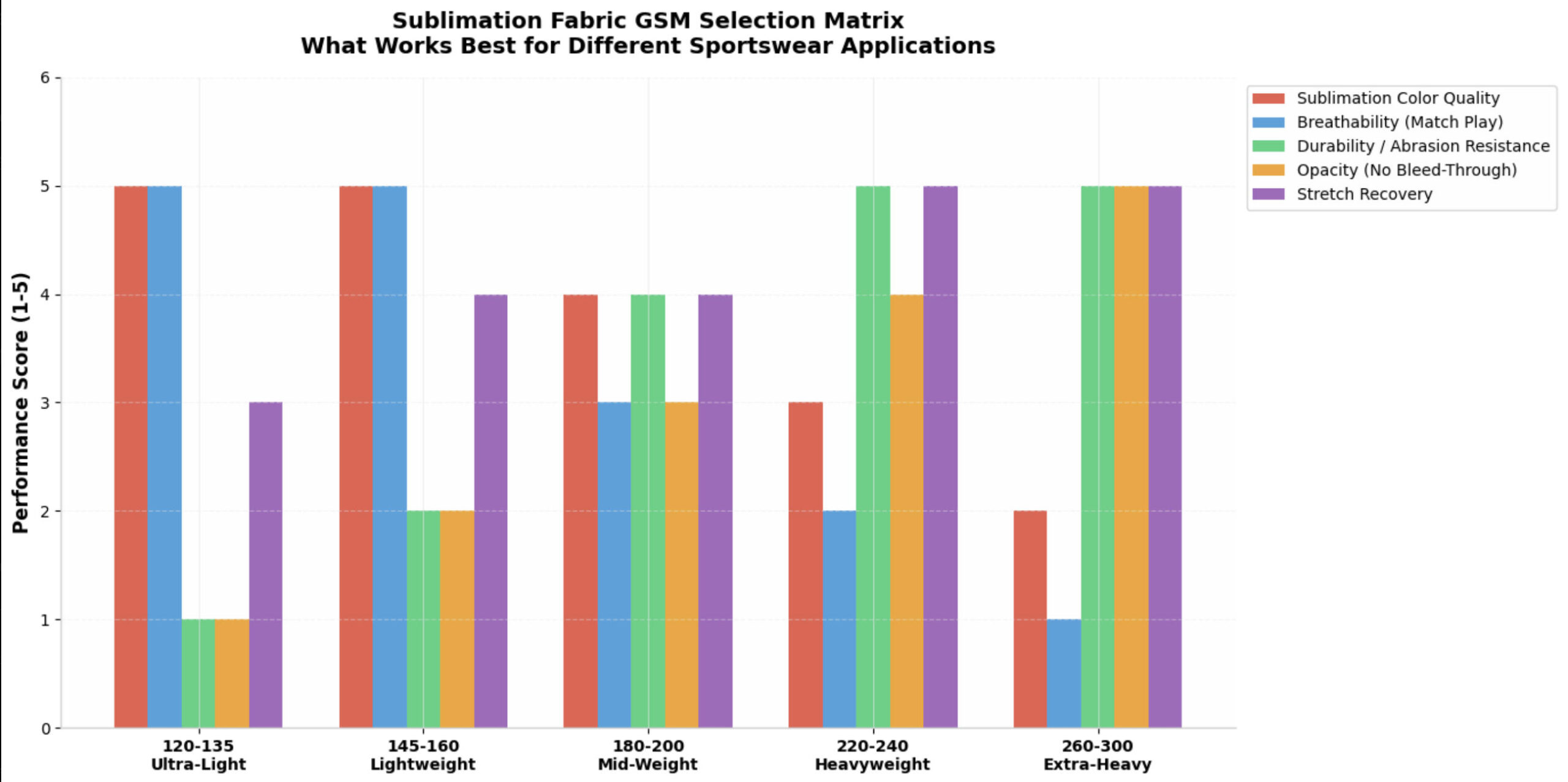
What the Chart Shows
120–135gsm Ultra-Light: Maximum color brilliance and breathability, but terrible durability and opacity. The dye penetrates beautifully because the fabric is thin, but it will bleed through to the backside on dark designs. It will also tear at the seams under athletic stress. This is pro-match-only territory, handled with care.
145–160gsm Lightweight: The sweet spot for most sublimation soccer jerseys. Breathability is excellent, color quality is excellent, and durability is acceptable for a season of play. This is what most competitive clubs should order.
180–200gsm Mid-Weight: The training kit standard. Less breathable for match play in heat, but survives daily washing and rougher handling. Good for basketball, rugby, and contact sports where abrasion matters.
220–240gsm Heavyweight: The contact-sport standard. Excellent durability and opacity, but you sacrifice breathability. Great for football, hockey, and goalie jerseys. Not ideal for outfield soccer in warm climates.
260–300gsm Extra-Heavy: Fan merchandise and reversible jerseys. The dye has trouble penetrating evenly at this weight, and players will overheat. Use only for fashion or streetwear, not performance.
Knit Structures: The Hidden Variable That Changes Everything
Two fabrics can have the same GSM and 100% polyester composition, but produce completely different sublimation results because of how they are knitted.
The Five Knit Structures for Sublimation
| Knit Structure | Surface | Best For | Sublimation Behavior | Cost Factor |
|---|---|---|---|---|
| Birdseye Mesh | Textured, small geometric pockets | Soccer, running, hot-weather sports | Excellent dye uptake; texture hides minor imperfections | Baseline |
| Pique | Waffle-like, larger geometric pattern | Golf, polo, casual sportswear | Good dye uptake; texture creates visual interest | Baseline |
| Interlock | Smooth, double-layered | Basketball, training, premium casual | Denser surface; dye can pool slightly at seams | +15% |
| Jersey (Single Knit) | Smooth, flat | T-shirts, base layers, fashion | Very smooth print surface; shows every flaw | -10% |
| Tricot Mesh | Large open holes | Practice bibs, warm-weather training | Dye passes through holes; limited to specific designs | +5% |
Birdseye Mesh: The Soccer Standard
Birdseye mesh is the default recommendation for sublimation soccer jerseys because the knit structure creates tiny air pockets between raised and recessed areas. This does two things:
-
It breathes. The pockets allow air to circulate against the skin, which is why 160gsm birdseye mesh can feel cooler than 180gsm flat jersey.
-
It forgives. The textured surface hides minor sublimation imperfections—slight color shifts, tiny registration errors—that would be glaringly obvious on a smooth flat knit.
For a soccer uniform manufacturer, birdseye mesh is the workhorse. It sublimates consistently, wears reasonably well, and hits the price point that most clubs need.
Interlock: The Durability Play
Interlock is essentially two layers of jersey knit bonded together. It is smoother and more substantial than birdseye, with zero torque (the fabric does not twist on the body).
For sublimation, interlock has one downside: the denser surface means dye can pool slightly at seam intersections, creating darker lines where panels meet. A skilled manufacturer controls this by adjusting ink load and heat press dwell time. An amateur manufacturer delivers jerseys with visible seam shadows.
Interlock is worth the extra cost for basketball, rugby, and any sport where the jersey is grabbed, pulled, or washed daily. For soccer match play in moderate climates, birdseye is usually sufficient.
Jersey (Single Knit): The Smooth Canvas
Single-knit jersey is the smoothest surface for sublimation, which makes it ideal for designs with fine detail, small text, or photographic imagery. The trade-off is that every imperfection is visible. If the sublimation registration is off by 1mm, you will see it. If there is a slight color banding, you will see it.
This is why many budget decorators use single-knit jersey: it looks great in the product photo but fails under scrutiny. For a professional sublimation sportswear manufacturer, single-knit jersey is reserved for fashion and lifestyle pieces where the wearer is not sweating and sliding.
The D/F Specification: The Technical Detail That Determines Color Quality
Most buyers have never heard of D/F. It is the single most important fabric specification that determines how vibrant your sublimation will look.
D = Denier. The thickness of the yarn. 75D is standard. 50D is finer and softer. 100D is heavier and stiffer.
F = Filament count. How many individual micro-strands make up the yarn. 36F means 36 thick strands. 72F means 72 thinner strands. 144F means 144 very fine strands.
Why this matters for sublimation:
When disperse dye gas hits the polyester fiber, it bonds with the surface area of the yarn. A 75D/144F yarn has exponentially more surface area than a 75D/36F yarn because the 144 filaments are much thinner and more numerous.
The result: Higher filament counts produce more vibrant, more uniform color. The dye distributes across more surface area, eliminating the “mottled” or “streaky” look that cheap fabrics sometimes show in large solid color fields.
Practical specification for buyers:
-
50D/72F: Ultra-soft, premium feel. Excellent for high-end match kits. Less durable.
-
75D/72F: The standard. Balanced color quality, durability, and cost. Best for most team orders.
-
75D/36F: Coarser hand-feel. Cheaper. Acceptable for budget uniforms but shows less vibrant color.
-
100D/48F: Heavy duty. Used for football and hockey. Sublimation is slightly less vivid due to lower filament count relative to weight.
If your sublimation sportswear manufacturer cannot tell you the D/F of their house fabric, they are buying commodity fabric from a trading market. They do not control their supply chain.
Color Opacity and Bleed-Through: The White Panel Problem
One of the most common sublimation failures is bleed-through. You design a jersey with a white chest panel for the sponsor logo. The factory prints it. The white panel has a pink or blue halo seeping in from the surrounding color.
This happens because of fabric opacity. When the fabric is too thin (below 140gsm), the dye from the backside migrates through to the front. The white area is no longer white. It is contaminated.
How manufacturers solve this:
-
Use heavier fabric. 160gsm+ provides enough density to prevent bleed-through in most designs.
-
Use double-layer construction. For critical white panels, some manufacturers sew a white fabric backing behind the panel to block migration.
-
Reduce ink load on adjacent areas. Less dye means less migration. But this requires calibrated RIP software and experienced operators.
-
Use barrier paper. During heat pressing, a special paper is placed behind the fabric to catch migrating dye.
If you are designing a jersey with large white or light-colored fields, tell your manufacturer upfront. A professional soccer uniform manufacturer will adjust the production parameters to protect those areas.
Functional Finishes: What Happens After the Dye Bonds
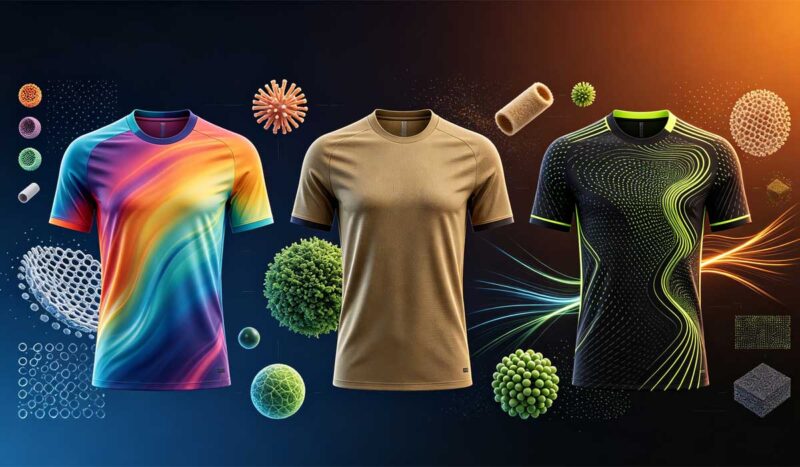
The fabric can be treated with functional finishes either before sublimation (at the fiber stage) or after (as a topical treatment). These finishes affect performance but can also affect sublimation quality.
Moisture-Wicking
Standard polyester is hydrophobic—it repels water. But it does not necessarily move sweat efficiently. Wicking treatments create hydrophilic channels in the fiber that draw moisture from the skin to the outer surface for evaporation.
Impact on sublimation: Minimal, if the treatment is applied at the fiber extrusion stage. If applied topically after sublimation, it can create a slight barrier that reduces wicking effectiveness over time. Specify fiber-level wicking, not spray-on.
Antimicrobial
Silver-ion treatments prevent bacterial growth, which is critical for gear that gets sweaty and sits in gym bags.
Impact on sublimation: Silver-ion masterbatch mixed during fiber extrusion has no effect on sublimation. Topical antimicrobial sprays can create a surface film that interferes with dye penetration. Again, specify fiber-level treatment.
UV Protection (UPF)
Titanium dioxide (TiO2) integrated during fiber production blocks UV radiation. This is important for outdoor sports.
Impact on sublimation: TiO2 can slightly dull very bright colors (yellows, neon greens) because the white pigment scatters light. A skilled manufacturer compensates by increasing ink density in the RIP profile.
Flame Retardant
Required for some institutional buyers (military, certain school districts).
Impact on sublimation: Flame retardant treatments can interfere with dye bonding. If you need FR certification, your manufacturer must use a polyester specifically engineered for both FR and sublimation compatibility. Do not assume standard sublimation fabric will pass FR testing.
Sustainable Sublimation: rPET and Bio-Based Options
The demand for sustainable sportswear is growing, and sublimation is actually well-positioned for this shift.
rPET (Recycled Polyester)
rPET is made from post-consumer plastic bottles. The performance is identical to virgin polyester when processed correctly. The sublimation behavior is the same.
What to verify:
-
GRS certification (Global Recycled Standard): Ensures chain of custody from bottle to fiber.
-
Chip-dyeing: The color is added during the pellet stage, not after extrusion. This prevents the streaking that can occur if recycled feedstock is contaminated.
-
Content claim: Each meter of rPET fabric should come with a certificate stating the percentage of recycled content.
Cost: rPET adds 10–15% to fabric cost but qualifies for sustainability premiums and certain tax incentives in the EU and some US states.
Bio-Based Polyester
Some manufacturers now offer polyester derived from plant starch (like DuPont Sorona®). These are not yet mainstream for sublimation because the melting point is lower (220°C vs. 255°C for standard polyester), which requires adjusted heat press parameters.
Current status: Interesting for sustainability storytelling, but most sublimation sportswear manufacturers still recommend rPET as the practical eco-option.
The Five Fabric Mistakes That Ruin Sublimation Orders
Mistake 1: Ordering “Cotton-Feel” Polyester
Cotton-feel polyester is mechanically softened to mimic natural fiber. This softening process often involves silicone treatments or mechanical abrasion that can interfere with dye bonding. After 10–15 washes, the softening effect wears off anyway, and you are left with standard polyester that may have sublimation adhesion issues.
Mistake 2: Using Too-Light Fabric for Dark Designs
If your design has large black or navy fields adjacent to white fields, do not use 130gsm fabric. The dye will migrate. Use 160gsm minimum, or accept that you need a white backing layer.
Mistake 3: Ignoring the D/F Specification
A factory that says “it’s 100% polyester” has told you nothing. Ask for the D/F. If they say “we don’t know,” you are buying commodity fabric that will produce mediocre color.
Mistake 4: Specifying Interlock for All-Over Photo Prints
Interlock’s double-knit density can cause dye pooling at seams. For photographic all-over designs, birdseye mesh or single-knit jersey produces more consistent results.
Mistake 5: Not Testing Wash Durability
Always request a wash-test sample. A reputable manufacturer will wash a sample 5–10 times and provide photos. If they refuse, they are not confident in their fabric.
How to Specify Fabric to Your Sublimation Sportswear Manufacturer
When you send a tech pack or design brief, include this fabric specification block:
FABRIC SPECIFICATION:
- Composition: 100% Polyester
- GSM: 160gsm (match) / 180gsm (training)
- Knit Structure: Birdseye Mesh
- Yarn Spec: 75D/72F
- Finish: Moisture-wicking (fiber-level), Antimicrobial (Ag+, fiber-level)
- Certification: OEKO-TEX Standard 100
- Color: White (sublimation base)
- Opacity: Minimum 95% (no bleed-through)
If your manufacturer cannot confirm every line of this specification, they are not controlling their supply chain. They are buying whatever is cheapest on the market that week.
Frequently Asked Questions
Q1: What fabrics work best for sublimation?
A: The best fabric for sublimation is 100% polyester with a high filament count (72F or higher) in a lightweight to mid-weight construction (145–180gsm). For most sportswear applications, 160gsm birdseye mesh polyester with 75D/72F yarn is the optimal balance of color vibrancy, breathability, and durability. The birdseye texture provides natural ventilation and hides minor sublimation imperfections, while the 72F filament count ensures maximum dye uptake and uniform color distribution.
Q2: Can you sublimate on cotton or cotton-blend fabrics?
A: No. True sublimation requires 100% polyester because disperse dyes only bond with polyester polymer chains. On cotton or cotton-poly blends, the dye sits on the surface and washes out. A 50/50 cotton-poly blend will produce a faded, mottled appearance after the first wash because the dye bonds with the polyester fibers but not the cotton. If you need a cotton feel, order cotton practice shirts separately and keep the match kits in 100% polyester.
Q3: What is the best fabric for sublimation soccer jerseys?
A: For sublimation soccer jerseys, 160gsm birdseye mesh polyester (75D/72F) is the industry standard. It provides the breathability needed for 90 minutes of continuous running, the structural integrity to survive sliding tackles, and the surface texture that produces vibrant, consistent sublimation color. For training kits that face daily washing, 180gsm interlock polyester offers more durability at the cost of slightly reduced ventilation.
Q4: Does fabric weight (GSM) affect sublimation quality?
A: Yes. Lighter fabrics (120–160gsm) produce the most vibrant sublimation because the dye penetrates easily and the lower density allows better color saturation. However, very light fabrics (under 140gsm) lack opacity and may show bleed-through from the backside. Heavier fabrics (220gsm+) are more durable but can produce slightly duller colors because the dye must penetrate denser fiber construction. The sweet spot for most applications is 145–180gsm.
Q5: What is the difference between birdseye mesh and interlock for sublimation?
A: Birdseye mesh has a textured, geometric knit structure with tiny ventilation pockets. It breathes better, sublimates very consistently, and hides minor imperfections. It is ideal for soccer, running, and hot-weather sports. Interlock is a double-knit construction that is smoother, heavier, and more stable. It is more durable and resistant to grabbing, but slightly less breathable. For sublimation, interlock can show dye pooling at seams if not carefully managed. Interlock is better for basketball and contact sports; birdseye is better for soccer.
Q6: What is D/F, and why does it matter for sublimation?
A: D/F stands for Denier/Filament. Denier is the yarn thickness; Filament count is how many micro-strands make up the yarn. A 75D/72F yarn has 72 thin filaments bundled together, creating more surface area for dye bonding than a 75D/36F yarn with 36 thicker filaments. Higher filament counts (72F, 96F, 144F) produce more vibrant, uniform sublimation color. Always ask your sublimation sportswear manufacturer for the D/F specification of their fabric.
Q7: Can you prevent dye bleed-through on white fabric panels?
A: Yes, but it requires the right fabric and production technique. Use 160gsm+ fabric for adequate opacity. The manufacturer can also reduce ink load on adjacent colored areas, use barrier paper during heat pressing, or construct the panel with a white backing layer. If your design has large white fields next to dark colors, communicate this to your manufacturer before production. A professional soccer uniform manufacturer will adjust RIP profiles and press parameters to protect white areas.
Q8: Is recycled polyester (rPET) good for sublimation?
A: Yes, when processed correctly. rPET (recycled polyester from plastic bottles) performs identically to virgin polyester for sublimation if the manufacturer uses chip-dyeing (adding color during the pellet stage) and maintains clean feedstock. Look for GRS certification to verify the recycled content claim. rPET costs 10–15% more but offers the same color quality and allows brands to market sustainability credentials. Avoid rPET from suppliers who cannot provide GRS documentation.
Q9: What fabric should I avoid for sublimation?
A: Avoid four fabrics: (1) Cotton or cotton blends—dye will not bond; (2) Nylon—dye bonds but shifts color unpredictably; (3) “Cotton-feel” polyester with heavy silicone treatment—can interfere with dye adhesion; and (4) Very lightweight polyester under 130gsm—lacks opacity and durability for sportswear. Also avoid fabrics with topical (spray-on) finishes rather than fiber-level treatments, as the finish can degrade sublimation quality.
Q10: How do I know if my manufacturer is using quality sublimation fabric?
A: Ask for four things: (1) the exact GSM and knit structure (they should say “160gsm birdseye mesh” not just “polyester”); (2) the D/F specification (they should know 75D/72F or similar); (3) fabric test reports showing shrinkage, color fastness, and moisture regain; and (4) OEKO-TEX or equivalent certification. If a supplier cannot provide these details, they are buying commodity fabric from a trading market and do not control their supply chain.
Q11: Does sublimation fabric need special care after production?
A: Sublimated polyester is low-maintenance. Recommend cold or warm wash (not hot), hang dry or tumble dry low, and avoid fabric softeners (which coat fibers and reduce wicking performance). Do not iron directly over sublimated areas at high heat, though the decoration itself is heat-resistant up to 200°C. The fabric will outlast the stitching before the sublimation fades.
Q12: What is the most cost-effective fabric for bulk sublimation orders?
A: For bulk team orders (100+ pieces), 160gsm birdseye mesh polyester (75D/72F) offers the best cost-to-performance ratio. It is affordable, sublimates beautifully, and survives a season of play. Going cheaper to 130–140gsm saves pennies per unit but produces jerseys that tear, bleed, and disappoint. Going more expensive to 180gsm interlock adds cost that is only justified for training kits or contact sports. For standard soccer match kits, 160gsm birdseye is the value sweet spot.
Conclusion: The Fabric Is the Foundation
You can have the most beautiful design file in the world. You can have the most advanced sublimation printer. But if the fabric is wrong—too thin, too coarse, the wrong knit structure, the wrong filament count—the final product will fail.
When you work with a sublimation sportswear manufacturer, the fabric specification should be the first conversation, not an afterthought. A professional manufacturer will ask about your sport, your climate, your design complexity, and your durability needs before they recommend a fabric. They will know the D/F specification of their house fabric. They will have test reports. They will understand why 160gsm birdseye mesh is the soccer standard and why 220gsm interlock is the basketball standard.
The fabric is not just a blank canvas. It is an active participant in the chemical process that creates your final product. Choose it with the same care you choose your design.
About the Author:
Technical production team at a custom sportswear manufacturing facility with 17 years of experience in dye-sublimation engineering, fabric specification, and team uniform production for soccer, basketball, and volleyball programs.
Technical production team at a custom sportswear manufacturing facility with 17 years of experience in dye-sublimation engineering, fabric specification, and team uniform production for soccer, basketball, and volleyball programs.
Last Updated: July 2026
Related Reading: