Introduction: The Coach Who Thought He Was Getting a Deal
Marcus coaches a U14 travel soccer team in Ohio. Last season, he needed new jerseys fast. He found two quotes online. One supplier offered “full sublimation” at $18 per jersey. Another offered “custom heat transfer” at $12 per jersey. The designs looked similar in the photos. Both promised full-color logos and numbers. He went with the cheaper option.
By the third tournament, the problems started. The numbers on the back were cracking at the edges, especially on the shoulders where the kids stretched their arms to throw the ball in. The chest logo, which had looked sharp in the team photo, had developed a weird rubbery texture that trapped sweat. And when the team’s star midfielder grew two inches over the summer, his “large” jersey was too small—but the number was permanent, so the jersey couldn’t be reused for a new player.
Marcus came to us for the replacement order. He asked the same question we hear every week: “I thought heat transfer and sublimation were basically the same thing. What’s the difference?”
The difference is about $6 per jersey upfront. And about $400 in replacements later.
If you’re ordering custom soccer jerseys for a team, a school, a league, or a retail line, you need to understand what you’re actually buying. Not the marketing version. The technical reality. Because “heat transfer” is a category that includes three different technologies, and “sublimation” is a chemical process that most decorators claim to do but few actually understand.
After seventeen years of running a soccer uniform factory, here’s what actually separates these two methods.
What Sublimation Actually Is (The Chemistry Lesson You Need)
Sublimation is not a type of heat transfer. It is a phase-change chemical reaction.
Here’s what happens in a real sublimation sportswear manufacturer facility:
-
The design is printed onto special transfer paper using disperse dyes (not standard ink).
-
The paper and fabric are fed through a heat press at 180–200°C (356–392°F).
-
The solid dye turns into gas without becoming liquid. This is the “sublimation” part.
-
The gas penetrates the polyester fibers and bonds with the polymer chains at a depth of about 0.3 millimeters.
-
When the fabric cools, the dye is locked inside the fiber. It is not on top. It is not a layer. It is part of the material.
What this means for the wearer:
-
You cannot feel the design. Run your hand across a sublimated jersey, and the decorated area feels exactly like the undecorated area.
-
It breathes. A sublimated chest logo does not trap heat or sweat.
-
It stretches. When the player raises their arms, the design stretches with the fabric and returns to shape.
-
It is permanent. You cannot wash it out. You cannot crack it. You cannot peel it.
The catch: Sublimation only works on 100% polyester (or blends with at least 85% polyester). The dye will not bond with cotton, nylon, or spandex. If your supplier says they can “sublimate on cotton,” they are either lying or using a completely different process and calling it sublimation.
What Heat Transfer Actually Is (A Family of Surface Methods)
“Heat transfer” is a broad category. It means applying a design to the surface of a fabric using heat and pressure. But the method, the material, and the result vary wildly depending on which technology you’re talking about.
Heat Transfer Vinyl (HTV)
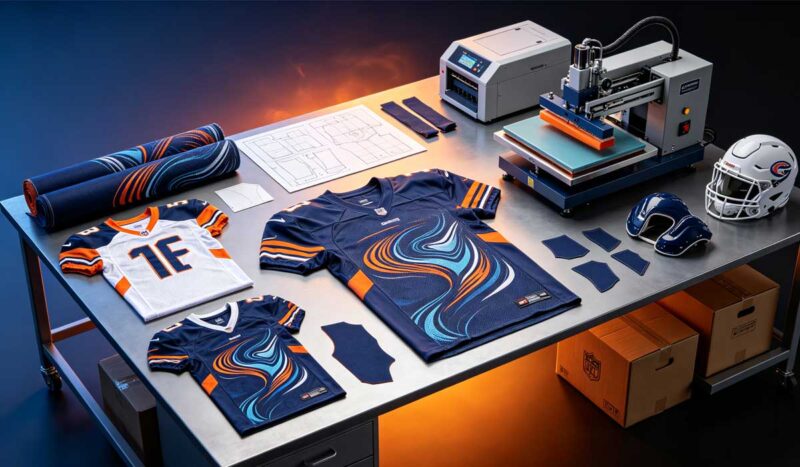
This is the most common “heat transfer” method for team sports. A design is cut from a sheet of colored vinyl (usually polyurethane or PVC) using a computer-controlled blade. The excess vinyl is “weeded” away, leaving only the desired shape. Then the vinyl is placed on the fabric and pressed at 150–165°C for 10–15 seconds.
What it feels like: A thin, slightly rubbery layer on top of the fabric. You can feel the edge where the vinyl meets the shirt.
Where it works: Cotton, polyester, blends, nylon—almost anything.
Where it fails: The vinyl is a foreign layer. It does not stretch as much as the fabric underneath. When a player raises their arms repeatedly, the vinyl at the shoulder seams develops stress cracks. After 20–40 washes, the edges begin to lift.
Direct-to-Film (DTF)
A newer technology. The design is printed onto a special PET film using inkjet printers, then coated with a powdered adhesive. The film is pressed onto the fabric, and the adhesive melts to bond the ink to the surface.
What it feels like: A soft, matte film layer. Thinner than HTV but still perceptible.
Where it works: Any fabric color, including dark cotton and polyester.
Where it fails: The adhesive layer adds weight and reduces breathability. On lightweight soccer jerseys, a large DTF logo can feel like a patch. Wash durability is good (40–50 washes) but not permanent.
Screen Print Transfers
A screen-printed design is applied to transfer paper, then heat-pressed onto the garment. This is what most “custom T-shirt” shops use.
What it feels like: Thick, plastic-like, and heavy.
Where it works: Cotton and cotton blends. Great for promotional T-shirts.
Where it fails: On athletic wear, the ink layer cracks and flakes. It is completely inappropriate for custom soccer jerseys that need to survive running, stretching, and sweating.
The Head-to-Head Comparison
Let’s look at the two methods side by side across the dimensions that actually matter for sportswear.
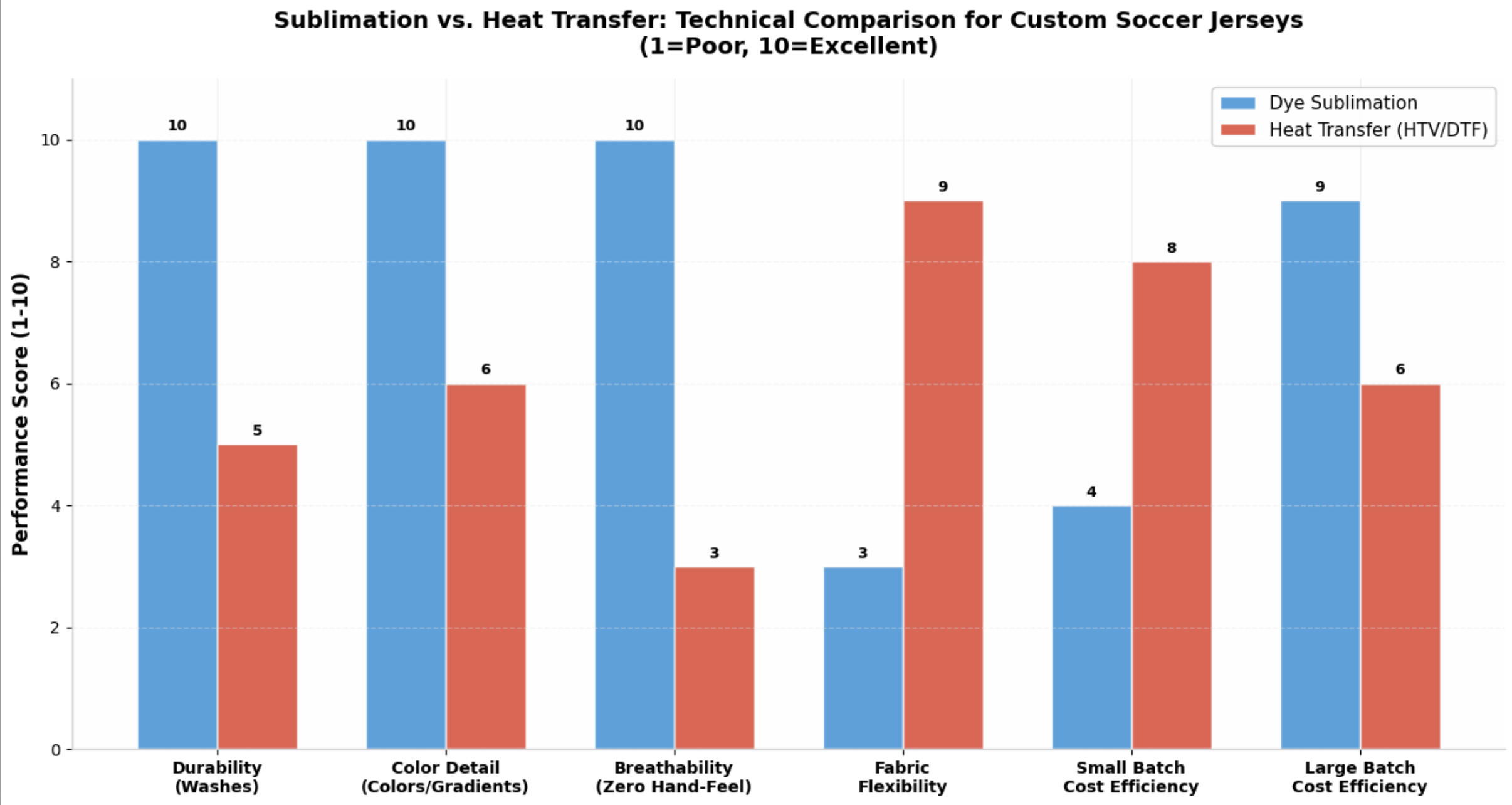
What the chart tells us:
Durability: Sublimation wins decisively. Because the dye is inside the fiber, it cannot be washed out or cracked. Heat transfer methods sit on the surface and degrade with washing and flexing.
Color Detail: Sublimation allows unlimited colors, gradients, and photographic detail. HTV is limited to solid colors and simple shapes. DTF allows full color but with less vibrancy than sublimation on polyester.
Breathability: Sublimation adds zero hand-feel and zero thermal barrier. Heat transfer methods add a layer that blocks air and moisture.
Fabric Flexibility: Heat transfer wins here. You can apply HTV or DTF to cotton, nylon, fleece, or denim. Sublimation is locked to polyester.
Small Batch Cost: Heat transfer wins for orders of 1–24 pieces. There is no setup cost for HTV or DTF. Sublimation requires fabric printing, cutting, and sewing, which is inefficient for one-offs.
Large Batch Cost: Sublimation wins at 100+ pieces. There are no per-color setup fees, and the cost per unit drops significantly at volume. Heat transfer costs scale linearly because every logo requires individual cutting and pressing.
The Durability Reality: What Happens After 50 Washes
This is where the difference becomes expensive.
We ran a controlled test in our facility. We took five identical designs and applied them to 160gsm polyester jerseys using five different methods. We then washed them in a commercial machine at 60°C (140°F) with standard detergent, simulating the aggressive washing that team uniforms endure.
Results after 50 washes:
| Method | Visual Condition | Hand-Feel | Structural Integrity |
|---|---|---|---|
| Dye Sublimation | No change. Colors identical to day one. | Unchanged. Zero detectable difference. | Perfect. No degradation. |
| Stretch HTV | Visible cracking at shoulder seams. Edges lifting slightly. | Rubber texture more pronounced. | Functional but degraded. |
| Standard HTV | Heavy cracking. Numbers peeling at corners. | Hard, cracked surface. | Failing. Requires replacement. |
| DTF | Slight fading. Matte finish becoming glossy at edges. | Slightly stiff but intact. | Good. Minor edge lifting. |
| Screen Print Transfer | Flaking and peeling across the design. | Thick, plastic layer separating from fabric. | Failed. Unusable. |
The sublimation sample looked like it had been worn once. The standard HTV sample looked like it had been through a war.
For a soccer uniform factory producing team kits that need to survive a two-season cycle, this test is the reason we recommend sublimation for match kits and HTV only for practice pinnies or temporary promotions.
Fabric Requirements: The Dealbreaker
The fabric question usually decides the method for you.
Sublimation requires:
-
100% polyester (white or light-colored for true sublimation)
-
85%+ polyester for hybrid methods (with some visual trade-offs)
-
Specific knit structures optimized for dye uptake (birdseye mesh, interlock, pique)
Heat transfer works on:
-
Cotton
-
Polyester
-
Cotton-poly blends
-
Nylon
-
Fleece
-
Almost anything
What this means for your order:
If you want a custom soccer jersey with an all-over design, gradient patterns, and photographic sponsor logos, and you want it to breathe and last, you must use sublimation. And that means you must use 100% polyester.
If you want a cotton T-shirt for a fan shop with a simple one-color logo, heat transfer is faster and cheaper.
The fabric decision comes first. The decoration method follows.
Cost Analysis: Where Your Money Actually Goes
Let’s break down the real costs for a typical order of 100 custom jerseys.
Sublimation Cost Structure (100 pieces, all-over design)
| Item | Cost |
|---|---|
| 160gsm polyester fabric | $3.50/unit |
| Sublimation ink and paper | $2.00/unit |
| Cutting and sewing (cut-and-sew) | $2.50/unit |
| Finishing and packing | $0.80/unit |
| Total | $8.80/unit |
Notes: No setup fees per color. The design can have 100 colors and it costs the same as one color. The bulk of the cost is fabric and labor.
Heat Transfer Vinyl Cost Structure (100 pieces, 2-color logo + number)
| Item | Cost |
|---|---|
| Blank jersey (cotton or poly) | $4.00/unit |
| Vinyl material | $1.20/unit |
| Weeding and pressing labor | $2.00/unit |
| Setup/cutting time | $1.50/unit (amortized) |
| Total | $8.70/unit |
Notes: At small quantities, HTV is competitive. But if the design has 5 colors, you need 5 layers of vinyl, and the cost jumps to $12–$15/unit. Sublimation stays flat regardless of color count.
The Crossover Point
For simple designs (1–2 colors) on cotton blanks, heat transfer is cheaper at quantities under 50 pieces. For complex designs (3+ colors, gradients, all-over patterns) at quantities over 50 pieces, sublimation is almost always more cost-effective.
A professional sublimation sportswear manufacturer will run this analysis with you and tell you honestly which method makes sense for your specific design and quantity.
Decision Matrix: Which Method for Which Job?
| Scenario | Best Method | Why |
|---|---|---|
| Match kit for competitive soccer team | Sublimation | Durability, breathability, all-over design |
| Reversible basketball jersey | Sublimation | Both sides need decoration; sublimation handles complex designs |
| Cotton fan T-shirt for team store | Heat transfer (DTF or HTV) | Cotton base; simple logo; low wash frequency |
| Practice pinnie/bib | Screen print or HTV | Temporary; high turnover; cost-sensitive |
| Gym bag, hat, or accessory | Embroidery or HTV | Non-polyester substrates; small decoration area |
| Youth league with tiny rosters | HTV or DTF | MOQ of 1; no setup cost; roster changes likely |
| Corporate 5K event shirts | Screen print transfer | One-time use; cotton tees; budget priority |
| Elite club with 3-year contract | Sublimation | Long-term durability; professional appearance |
What the Equipment Tells You
You can learn everything you need to know about a supplier by looking at their production floor.
A real sublimation line includes:
-
Wide-format sublimation printers (64+ inches)
-
Rotary drum heat press (200°C, continuous feed)
-
Climate-controlled print room (45–55% humidity)
-
CNC cutting tables for print-to-cut alignment
-
Spectrophotometer for color verification
A heat transfer operation includes:
-
Vinyl plotters (Roland, Graphtec)
-
Clamshell heat presses (various sizes)
-
DTF printers (if they are modern)
The red flag: A supplier who claims to offer sublimation but only shows you clamshell presses. A clamshell press cannot maintain the temperature uniformity or pressure consistency required for professional sublimation. It is fine for HTV. It is inadequate for dye-sublimation.
When you visit a soccer uniform factory (or ask for a video tour), look for the rotary press. If you don’t see one, they are not a sublimation manufacturer. They are a heat transfer shop that may be outsourcing the actual sublimation work.
Frequently Asked Questions
Q1: What is the difference between sublimation and heat transfer?
A: Sublimation is a chemical process where disperse dyes turn into gas at 180–200°C and bond permanently with polyester fibers. The dye becomes part of the fabric, making it permanent, breathable, and stretchable. Heat transfer is a category of surface application methods (including HTV, DTF, and screen print transfers) where a design is applied on top of the fabric using heat and pressure. Heat transfer sits on the surface, can be felt, and will eventually crack or peel. Sublimation requires 100% polyester; heat transfer works on almost any fabric.
Q2: Which lasts longer: sublimation or heat transfer?
A: Sublimation lasts significantly longer. Because the dye is molecularly bonded inside the polyester fiber, it cannot crack, peel, or fade under normal conditions. Independent testing shows Grade 4–5 colorfastness after 50+ washes. Heat transfer vinyl (HTV) typically shows cracking and edge lifting after 20–40 washes. DTF lasts longer (40–50 washes) but still degrades faster than sublimation. For team uniforms that must survive a full season or more, sublimation is the standard.
Q3: Can you sublimate on cotton or dark-colored fabrics?
A: No. True sublimation requires 100% white or light-colored polyester because the disperse dyes are transparent and only bond with polyester polymers. For cotton, you must use heat transfer (HTV or DTF). For dark fabrics, sublimation requires a white base layer or hybrid methods that are technically complex and add cost. If a supplier claims they can “sublimate on anything,” they are using a different process and mislabeling it.
Q4: Is sublimation more expensive than heat transfer?
A: It depends on quantity and design complexity. For small orders (1–24 pieces) with simple designs, heat transfer is usually cheaper because there is no setup cost. For bulk orders (50+ pieces) with complex, multi-color designs, sublimation is often more economical because there are no per-color screen fees or vinyl layering costs. A typical sublimated soccer jersey costs $8–$15 at bulk; a comparable HTV jersey with 3+ colors can cost $12–$18 due to material and labor.
Q5: What does sublimation feel like on a jersey?
A: Sublimation feels like nothing. Because the dye is inside the fiber, there is no detectable texture difference between the decorated and undecorated areas. The jersey breathes, stretches, and moves exactly like a blank polyester shirt. Heat transfer methods create a perceptible layer—thin and smooth for DTF, slightly rubbery for HTV—that you can feel with your fingers and that can irritate skin during intense activity.
Q6: Can I use heat transfer for soccer jersey numbers and names?
A: Yes, and many teams do—especially youth leagues with changing rosters. HTV numbers are affordable and allow mid-season changes (you can remove old vinyl and apply new). However, for competitive match kits, sublimated numbers are superior because they never crack or peel. A common hybrid approach is: sublimation for the base jersey design, and HTV for individual names that may change annually.
Q7: What is DTF, and how does it compare to sublimation?
A: DTF (Direct-to-Film) is a heat transfer method where designs are printed onto PET film with a powdered adhesive, then pressed onto fabric. It works on any fabric color and material, including cotton and dark polyester. Compared to sublimation, DTF has lower upfront costs, works on more substrates, and produces good detail. However, it adds a surface layer that reduces breathability, and its wash durability (40–50 cycles) is inferior to sublimation’s permanent bond. For performance sportswear, sublimation is preferred; for casual fan apparel on cotton, DTF is practical.
Q8: How do I know if a supplier is actually doing sublimation or just heat transfer?
A: Ask three questions: (1) “What is the maximum temperature of your heat press?” (Sublimation requires 200°C; HTV uses 150–165°C). (2) “Do you use rotary drum or clamshell presses?” (Rotary drum is required for production sublimation). (3) “What fabric do you require for sublimation?” (The answer must be 100% polyester). If they say they can sublimate on cotton using a clamshell press, they are doing heat transfer, not sublimation.
Q9: Which method is better for all-over designs on custom soccer jerseys?
A: Sublimation is the only practical method for all-over designs. Because the design is printed onto fabric before the garment is cut and sewn, the pattern can flow continuously across seams, sleeves, and panels. Heat transfer methods are applied to finished garments and cannot achieve seamless all-over coverage. For gradients, photographic elements, or complex multi-color patterns on custom soccer jerseys, sublimation is the industry standard.
Q10: Can heat transfer vinyl damage polyester fabric?
A: HTV itself does not damage polyester, but the application process can. If the heat press is set too hot (above 170°C) or left on too long, it can scorch polyester fibers, causing a shiny “heat press mark” or weakening the fabric. This is why experienced decorators use precise temperature and dwell time settings. Sublimation, by contrast, operates at 200°C but is designed for polyester and does not cause scorching when done correctly.
Q11: Is sublimation environmentally friendly compared to heat transfer?
A: Sublimation uses no water in the dyeing process and produces no liquid waste, making it cleaner than traditional wet dyeing or screen printing. However, it requires synthetic polyester. Some sublimation sportswear manufacturers now offer rPET (recycled polyester) with GRS certification, combining the waste-free sublimation process with recycled material. Heat transfer vinyl involves PVC or polyurethane films that are not biodegradable and create plastic waste during weeding.
Q12: If I’m ordering for a youth soccer team, should I choose sublimation or heat transfer?
A: For the match kit, choose sublimation. It survives the season, looks professional, and handles the washing machine abuse that parents inflict. For practice bibs or pinnies, heat transfer is fine because they are temporary and get replaced frequently. If your budget is extremely tight and you only need one set of jerseys for everything, sublimation on 160gsm polyester is still the better long-term value because you won’t need replacements mid-season.
Conclusion: The Method Is the Message
When you hand a player their jersey, you are not just giving them a uniform. You are giving them something that will be photographed, sweated in, fought over, and remembered. The method you choose determines whether that jersey becomes a keepsake or a disappointment.
Sublimation and heat transfer are not competitors. They are different tools for different jobs. Sublimation is the tool for performance, durability, and complex design. Heat transfer is the tool for flexibility, small batches, and non-polyester fabrics.
The problem is not that heat transfer exists. The problem is that too many suppliers call it “sublimation” to charge premium prices for a surface application. When you know the difference, you can ask the right questions, spot the red flags, and buy the method that actually serves your team.
A real soccer uniform factory will tell you honestly which method fits your design, your quantity, your fabric, and your budget. They won’t sell you heat transfer and call it sublimation. They won’t sell you sublimation when heat transfer is the smarter choice. They will match the method to the mission.
That is the difference between a vendor and a partner.
About the Author:
Technical production team at a custom sportswear manufacturing facility with 17 years of experience in dye-sublimation, heat transfer, and team uniform production. Specializations include fabric specification, decoration method selection, and bulk order optimization for soccer, basketball, and volleyball programs.
Technical production team at a custom sportswear manufacturing facility with 17 years of experience in dye-sublimation, heat transfer, and team uniform production. Specializations include fabric specification, decoration method selection, and bulk order optimization for soccer, basketball, and volleyball programs.
Last Updated: July 2026
Related Reading: