Introduction: The Quote That Was Too Good to Be True
Last fall, a coach from an AAU program in Georgia emailed me a quote he had received from a basketball jersey manufacturer he found online. The price was $9.50 per jersey. Fully customized. Sublimated. Numbers included. Shipping to his door in ten days. He wanted to know if he should pull the trigger.
I asked him three questions:
-
What is the GSM of the fabric?
-
What is the armscye depth on their basketball block?
-
Can they provide a CPSIA compliance certificate for the youth sizes?
He didn’t know the answer to any of them. The supplier, it turned out, had sent him a stock photo of a jersey from a completely different brand. They had no basketball-specific pattern. They were buying 160gsm lightweight polyester blanks from a wholesale market, slapping a generic “athletic fit” label on them, and heat-pressing numbers on top. Those jerseys would have lasted maybe six games before the numbers started peeling and the shoulder seams popped on his power forward.
He ended up working with us instead. Paid $14 per jersey. Got 220gsm double-knit fabric, a dropped armscye pattern engineered for shooting motion, and tackle twill numbers that survived the entire season plus summer league. His total cost of ownership was lower because he didn’t have to reorder.
The point? When you’re looking for a basketball jersey manufacturer, the sticker price is the least important number on the page. What matters is whether the factory understands what a basketball uniform actually does for forty minutes on a hardwood court.
After seventeen years of manufacturing team sportswear, here’s what we tell every coach, athletic director, and retailer who asks us: “What should I look for?”
First, Make Sure You’re Actually Talking to a Manufacturer
This sounds obvious, but it’s where most buyers trip. The internet is full of basketball jersey wholesalers who are not manufacturers. They’re trading companies, middlemen, or dropshippers who take your order, send it to a factory you’ve never met, and mark up the price 30–50%.
How to tell the difference:
| Question to Ask | Real Manufacturer | Trading Company |
|---|---|---|
| “Can I see a video of your cutting room?” | Yes—shows CNC tables, fabric rolls, sewing floor | No—shows a warehouse or office |
| “What is the D/F spec of your house basketball fabric?” | Answers immediately: “75D/72F, 220gsm double-knit” | Deflects: “It’s high-quality polyester” |
| “Do you have a basketball-specific pattern block?” | Yes—explains armscye depth, drop tail, side panel | No—uses “standard athletic fit” |
| “Can I get a fabric test report?” | Provides PDF with shrinkage, color fastness, abrasion | Says “available upon request” (means they don’t have it) |
| “What is your in-house decoration capability?” | Lists embroidery heads, heat presses, sublimation printers | Says “we work with partner factories” |
A real basketball jersey manufacturer owns the production. They control the fabric, the pattern, the cutting, and the sewing. A trading company controls nothing except your email address.
Why this matters: When something goes wrong—and eventually, something always goes wrong—a manufacturer can fix it. They can adjust the pattern, swap the fabric, or re-cut a batch. A trading company can only forward your complaint to a factory that doesn’t know your name and doesn’t care about your reorder.
Fabric Engineering: The Foundation Everything Else Sits On
If the fabric is wrong, nothing else matters. Not the logo. Not the price. Not the delivery date.
The GSM Decision
GSM (grams per square meter) is the weight of the fabric. For basketball, this single number determines how the jersey performs under stress.
| GSM | Weight | Best For | Why It Matters |
|---|---|---|---|
| 160–180gsm | Light | Practice jerseys, warm-ups, summer camps | Breathable but lacks stability for game contact |
| 200–220gsm | Medium-Heavy | Game uniforms (the sweet spot) | Resists grabbing, holds shape, survives washing |
| 240–280gsm | Heavy | Reversible jerseys, fan replicas, streetwear | Too warm for competitive indoor play |
For competitive basketball, 220gsm double-knit polyester is the industry standard. It has enough horizontal stability to resist the grab-and-pull of box-outs, enough weight to drape properly without clinging, and enough durability to survive industrial washing.
A bulk basketball uniforms supplier pushing 160gsm for game jerseys is selling you a product that will fail mid-season. The fabric will pill at the hips from floor contact, the numbers will shift because the substrate lacks stability, and the shirt will look like a hand-me-down by the playoffs.
Yarn Specifications: The Numbers Nobody Asks About
When you ask about fabric, most suppliers say “100% polyester.” That’s like saying “100% food.” It tells you nothing.
What you need to know:
-
Denier (D): The thickness of the yarn. 75D is standard for durability. 50D is finer and softer but less abrasion-resistant.
-
Filament count (F): How many micro-strands make up the yarn. 72F feels smoother than 36F because the individual filaments are thinner.
-
Knit structure: Double-knit (two layers interlocked) vs. single-knit pique vs. mesh.
Our recommendation: For basketball game jerseys, specify 75D/72F double-knit polyester at 220gsm. This construction provides the horizontal stability that basketball specifically demands.
The Fabric Comparison Chart
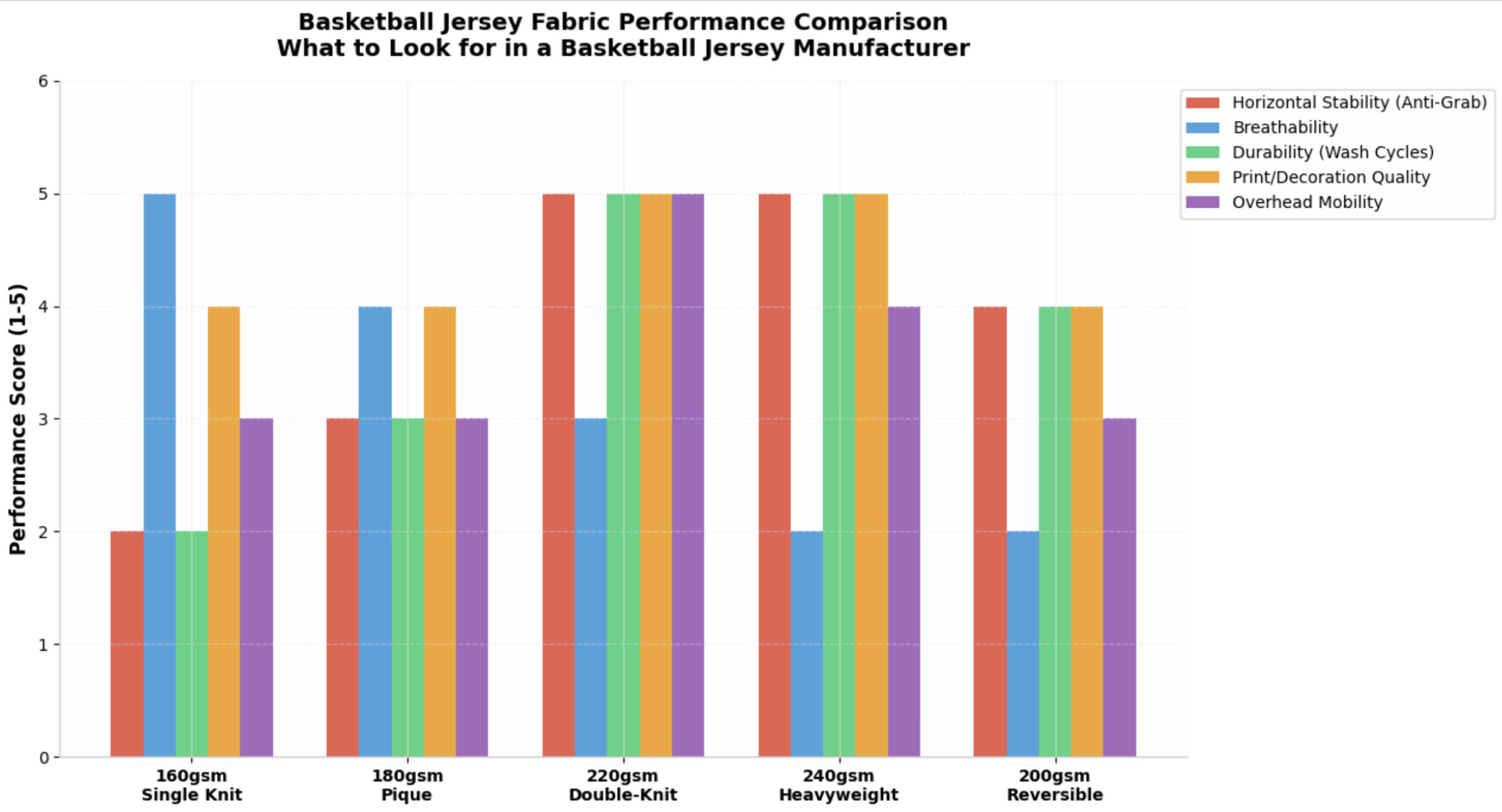
As the chart shows, 220gsm double-knit is the only fabric that scores high across all five performance categories that matter for basketball. It is the fabric that professional basketball jersey manufacturers specify as standard.
Pattern Engineering: The Fit That Makes or Breaks a Season
A basketball jersey is not a sleeveless T-shirt. It is a garment engineered for a specific range of motion. If your bulk basketball uniforms supplier does not have a basketball-specific pattern block, they are selling you a generic athletic cut that will fail on the court.
The Three Fit Points That Matter
1. Armscye Depth (The Armhole) Standard T-shirts are designed for 90 degrees of arm elevation. Basketball players routinely hit 180 degrees when shooting, rebounding, and blocking. If the armhole is too shallow, the side seam and sleeve binding cut into the armpit, restricting motion and causing chafing.
What to look for: A dropped armscye—lowered 1.5 to 2.5 centimeters below a standard T-shirt armhole. This allows full overhead motion without seam tension.
2. Torso Length and Drop Tail Basketball players spend significant time in defensive stances—knees bent, torso forward. A standard shirt length will pull out of the shorts, exposing the lower back.
What to look for: A back hem that extends 2–3 centimeters longer than the front hem (a “drop tail”). This keeps the jersey tucked or covered during low defensive positions.
3. Side Seam Position Standard athletic shirts place the side seam directly under the arm. For basketball, this creates a friction point during lateral defensive slides. A basketball-specific pattern shifts the side seam slightly posteriorly (toward the back), reducing contact and abrasion.
Gender-Specific Grading
If you’re ordering for girls’ or women’s teams, do not accept “unisex” sizing. Female basketball players have different shoulder-to-hip ratios than male players. A unisex medium will tent at the waist on female athletes or pull at the chest. A real basketball jersey manufacturer should offer separate women’s blocks with adjusted grading rules.
Decoration Methods: What Lasts and What Doesn’t
The logo and numbers are the most visible part of the jersey. They are also the most common failure point.
The Durability Comparison
| Method | Cost Per Jersey | Wash Survival | Best For | When It Fails |
|---|---|---|---|---|
| Sublimation | Baseline | Permanent | All-over designs, complex art | Never (if done right) |
| Tackle Twill | +$3–$5 | 200+ washes | Varsity, permanent rosters | After severe abrasion |
| Stretch HTV | +$1.50–$2.50 | 50+ washes | Youth leagues, changing rosters | If non-stretch vinyl used |
| Standard HTV | +$1–$2 | 20–30 washes | Budget promos | Cracks at shoulders quickly |
The sublimation advantage: For basketball jerseys with complex designs, gradients, or all-over patterns, sublimation is the only method that produces permanent, weightless, breathable decoration. The dye becomes part of the fiber.
The tackle twill advantage: For school programs with stable rosters, tackle twill numbers outlast the jersey itself. They have a dimensional, professional look that signals “varsity-level program.”
The HTV warning: Most youth league failures happen because the supplier used cheap, non-stretch vinyl. When a kid raises their arms to shoot, the vinyl at the shoulder cracks. Always specify stretch-compatible TPU vinyl with a 30% elongation rating.
Quality Control: The Factory Discipline That Protects You
A real basketball jersey manufacturer has a documented quality control system. Not “we check them before we ship.” A real system.
What to ask for:
-
Inline inspection: Random checks during sewing (every 10th unit) to catch construction errors before the garment is finished.
-
AQL final inspection: A standardized sampling plan (usually AQL 2.5 for major defects) where a percentage of the finished batch is measured, tested, and inspected.
-
Wash testing: A sample garment is washed 5–10 times to verify shrinkage and decoration adhesion.
-
Measurement verification: 15–20 points measured against the tech pack with documented tolerances.
Red flag: If a supplier says “our quality is guaranteed” but cannot show you a QC report, a tolerance chart, or a spectrophotometer reading, they do not have a quality system. They have a hope and a prayer.
Compliance and Documentation: The Boring Stuff That Saves Your Program
If you’re ordering for a school, a youth league, or a retail line, compliance is not optional. It is the paperwork that keeps you out of legal trouble.
What a legitimate basketball jersey manufacturer should provide:
-
OEKO-TEX Standard 100: Proves the fabric is free from harmful chemicals. Ask for the certificate number and verify it on the OEKO-TEX website.
-
CPSIA compliance (US): For youth jerseys (ages 12 and under). Requires lead testing and tracking labels.
-
BSCI or SA8000: Social compliance audits. Required by many institutional buyers and EU retailers.
-
ISO 9001: Quality management certification. Indicates the factory has documented processes.
The test: Email the supplier and ask for their OEKO-TEX certificate PDF. If they send it within two hours, they have it ready. If they say “we can get that,” they don’t have it.
Communication: The Tell That Separates Professionals from Pretenders
You can learn everything you need to know about a basketball jersey wholesaler by the questions they ask you before quoting.
A professional manufacturer will ask:
-
What level of play? (Rec, travel, high school, college?)
-
What is your climate and season? (Indoor winter, summer league, year-round?)
-
What is your roster size and gender breakdown?
-
Do you need individual names or just numbers?
-
What is your budget range per player?
-
Do you need CPSIA compliance for youth sizes?
-
When is your first game?
A trading company will ask:
-
How many pieces?
-
What color?
-
Send your logo.
The manufacturer is trying to engineer the right product for your specific situation. The trading company is trying to close a sale.
Communication speed matters too. A factory that takes three days to respond to a technical question is a factory that does not have technical staff. In our experience, the best basketball jersey manufacturers respond to technical inquiries within 24 hours because they have engineers and pattern makers on staff who can answer directly.
Pricing Transparency: The Quote That Tells the Truth
A legitimate bulk basketball uniforms supplier breaks down their pricing. A shady one hides it.
What a transparent quote looks like:
| Line Item | Cost | Notes |
|---|---|---|
| Fabric (220gsm double-knit) | $4.20 | 75D/72F, OEKO-TEX certified |
| Sublimation printing | $2.80 | All-over design, 4-color |
| Cutting & sewing | $2.50 | Basketball-specific pattern |
| HTV numbers (back) | $1.50 | Stretch TPU, 8-inch height |
| Trim & labels | $0.80 | Woven neck label, care label |
| Packing | $0.50 | Individual polybag |
| Total FOB | $12.30 | Per jersey at 100 pieces |
What a suspicious quote looks like:
“$11 per jersey. Free shipping. No setup fees.”
No breakdown, fabric spec, mention of decoration method. That quote is a trap. The supplier will either deliver an inferior product or hit you with hidden fees after you’ve paid the deposit.
Rule of thumb: If a quote for a fully customized 220gsm double-knit basketball jersey with sublimation and numbers is below $10 at 100 pieces, something is being cut. Either the fabric is lightweight, the decoration is cheap vinyl, or the quality control is nonexistent.
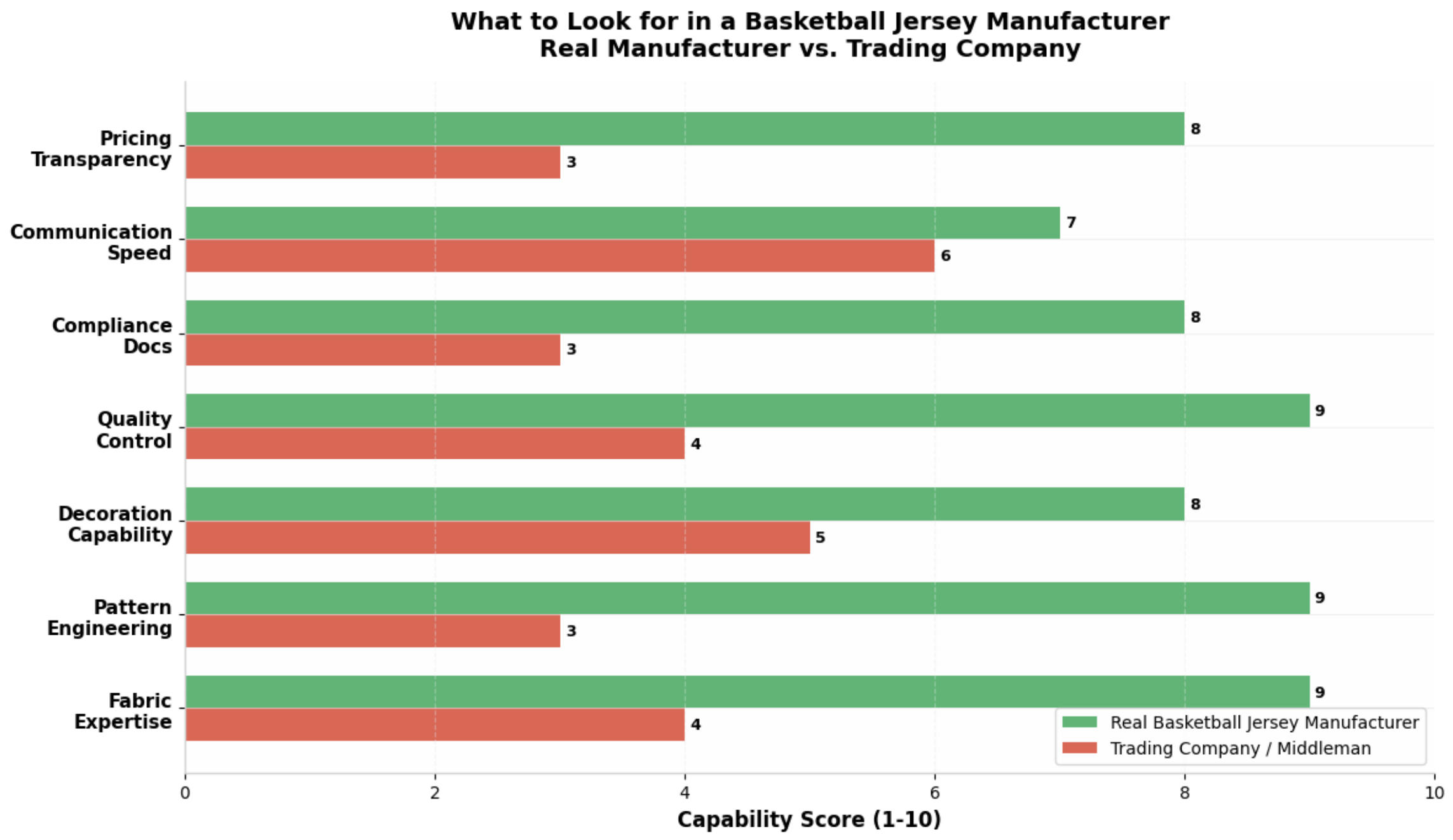
The Real Manufacturer vs. Trading Company Comparison
This chart summarizes the capability gap. A real manufacturer scores 8–9 out of 10 on the technical factors that determine product quality. A trading company scores 3–5 on those same factors because they don’t control production.
The one area where trading companies sometimes score higher is “communication speed”—because they have salespeople whose only job is to reply to emails quickly. But fast replies don’t fix a ripped shoulder seam.
Frequently Asked Questions
Q1: What should I look for first when evaluating a basketball jersey manufacturer?
A: Look for fabric expertise and pattern engineering. Ask what GSM they recommend for competitive basketball (should be 220gsm) and whether they have a basketball-specific pattern block with a dropped armscye. If they can’t answer both questions with specifics, they are not a basketball specialist. They are a general decorator.
Q2: What is the difference between a basketball jersey manufacturer and a basketball jersey wholesaler?
A: A basketball jersey manufacturer owns the production facility and controls fabric sourcing, pattern making, cutting, sewing, and decoration. A basketball jersey wholesaler may be a trading company that sources from multiple factories, marks up the price, and does not control quality. Manufacturers offer better technical customization and pricing. Wholesalers offer convenience and faster communication but less control.
Q3: What fabric weight is best for bulk basketball uniforms?
A: For competitive indoor basketball, 220gsm double-knit polyester is the standard. It provides the horizontal stability to resist grabbing during defense, the weight to drape properly without clinging, and the durability to survive a season of washing. For practice or summer camp jerseys, 180gsm is acceptable. For reversible jerseys, expect 280–320gsm total weight. Avoid 160gsm for game uniforms—it lacks the structural integrity for contact sports.
Q4: How do I know if a supplier is a real factory or just a middleman?
A: Ask for a video tour of the cutting room and sewing floor. Ask for the exact D/F specification of their house fabric (they should say something like “75D/72F”). Ask whether they have in-house sublimation printers or embroidery machines. A real factory will answer confidently and provide evidence. A middleman will deflect, delay, or say “we work with partner facilities.”
Q5: What decoration method is most durable for basketball jersey numbers?
A: Tackle twill (sewn fabric appliqué) is the most durable, surviving 200+ washes. It is the standard for varsity and college programs. Sublimation is permanent and weightless but limits you to polyester and does not allow mid-season number changes. Stretch HTV is the best budget option for youth leagues, but only if it is genuine stretch-compatible TPU vinyl. Standard non-stretch vinyl will crack at the shoulders after 5–10 games.
Q6: What is a reasonable price for bulk custom basketball jerseys?
A: For 220gsm double-knit polyester with sublimation and one HTV number, expect $12–$16 per jersey at 50–100 pieces. At 100–250 pieces, $10–$13. At 500+ pieces, $8–$11. Tackle twill numbers add $3–$5. Individual names add $1.50–$2.50. Prices below $10 for fully customized game jerseys usually indicate inferior fabric, poor decoration, or hidden fees.
Q7: What compliance documents do I need for youth basketball jerseys in the US?
A: For players ages 12 and under, you need CPSIA compliance, which includes lead content testing and permanent tracking labels on each garment. You should also request OEKO-TEX Standard 100 certification to verify the fabric is free from harmful chemicals. For school programs, BSCI or SA8000 social compliance may be required by the district. A legitimate manufacturer will have these documents ready.
Q8: How far in advance should I order custom basketball uniforms?
A: Plan 6–8 weeks before your first game. Sampling takes 7–10 days. Bulk production takes 15–20 days. Shipping takes 3–5 days (air) or 25–35 days (sea). Rush orders in 2–3 weeks are possible but cost 20–30% more and limit your fabric and color options. The teams that get the best results order early and use the extra time for sample approval.
Q9: Should I order reversible jerseys or separate home and away sets?
A: For youth leagues and tight budgets, reversible jerseys save money because you buy one garment instead of two. However, they are heavier (280–320gsm), warmer in the gym, and more expensive per unit than a single-sided jersey. For competitive high school and AAU programs, separate home and away sets are better because they are lighter, more comfortable, and allow for roster changes without affecting both sides.
Q10: What is the most common mistake when ordering bulk basketball uniforms?
A: The most common mistake is ordering based on price alone without verifying fabric weight, pattern specificity, and decoration durability. The second most common mistake is skipping the sample stage. A $100 investment in a fit set prevents a $2,000 disaster in bulk replacements. The third most common mistake is guessing sizes instead of measuring players and comparing to the factory’s size chart.
Q11: Can a basketball jersey manufacturer handle rush orders?
A: Yes, but with caveats. A factory can produce rush orders in 7–10 days if they use in-stock white or black fabric and have open production capacity. However, you will pay a 20–30% surcharge, and your color options will be limited to house stock. Custom dye colors and complex tackle twill applications cannot be rushed. If a supplier promises a fully customized order in 5 days without any limitations, they are cutting quality control.
Q12: What questions should I ask before I sign a contract with a basketball jersey manufacturer?
A: Ask these twelve questions:
-
What is the exact GSM and knit structure of your standard basketball fabric?
-
Do you have a basketball-specific pattern block, or do you use a generic athletic block?
-
What is your armscye depth on the basketball pattern?
-
What decoration methods do you offer in-house?
-
What is your quality control process (AQL level, inspection points)?
-
Can you provide OEKO-TEX and CPSIA documentation?
-
What is your MOQ for custom basketball jerseys?
-
What is your production timeline from sample approval to delivery?
-
Can you provide a graded size set before bulk production?
-
What is your policy for defective or mis-sized garments?
-
Do you offer stretch-compatible HTV for numbers?
-
Can I see a video of your production floor?
If a supplier cannot answer at least ten of these twelve questions satisfactorily, keep looking.
Conclusion: The Manufacturer Is Your Teammate
A basketball season is long. Practices, scrimmages, tournaments, playoffs. The jersey you put on that first day in November needs to look the same in February. The numbers need to stay on. The shoulder seams need to hold. The color needs to match the shorts.
When you choose a basketball jersey manufacturer, you are not just buying a product. You are choosing a teammate for your season. The right teammate shows up prepared, communicates clearly, and fixes problems before they become disasters. The wrong teammate disappears when the numbers start peeling.
1.Look for the factory that asks about your players, your climate, and your timeline before they quote.
2.Look for the factory that explains why 220gsm double-knit matters.
3.Look for the factory that sends fabric test reports without being asked.
That factory is out there. And now you know exactly how to find them.
About the Author:
Technical production team at a custom sportswear manufacturing facility with 17 years of experience producing basketball, soccer, and team uniforms for schools, clubs, and retailers across North America and Europe.
Technical production team at a custom sportswear manufacturing facility with 17 years of experience producing basketball, soccer, and team uniforms for schools, clubs, and retailers across North America and Europe.
Updated: July 2026
Related Reading: