Introduction: The Berlin Trade Show Booth That Changed Nothing
Three years ago, a founder from São Paulo spent eighteen thousand dollars on a booth at a major European apparel trade show. He had beautiful lookbooks. He had samples in three colorways. He had a brand story about sustainability and community. Over four days, roughly two hundred buyers walked past his display. About forty stopped to touch the fabric. Three took business cards. Zero placed orders.
When he emailed those three buyers two weeks later, two did not respond. The third replied with a single line: “Your pricing is 40% above our current supplier, and you have no compliance documentation. Best of luck.”
He had built a brand for local consumers. He had not built a brand for global buyers. Those are fundamentally different exercises.
A local brand sells aspiration, aesthetics, and community. A global brand sells predictability, scalability, and risk mitigation. International buyers—whether they are distributors in Germany, e-commerce aggregators in the United States, or boutique chains in Australia—are not looking for the next great creative vision. They are looking for a supplier who will deliver the right product, at the right cost, on the right date, with the right paperwork, every single time.
Over seventeen years of manufacturing for brands that range from two-person startups to multi-national retailers, we have learned that positioning a small apparel brand for global buyers is less about marketing and more about infrastructure. The brands that cross borders successfully are the ones that look like large suppliers in their systems, even if they are small in their headcount.
This is how you build that infrastructure.
The Positioning Problem: Why Small Brands Fail at Global Scale
Most small apparel brands fail at international expansion for one of three reasons:
1. They lead with creativity instead of capability. A buyer for a Dutch department store does not care about your founder’s artistic journey. They care whether your factory can produce ten thousand units with a defect rate below 2.5%. They care whether you have liability insurance. They care whether your hang tags comply with EU textile labeling regulations. If your brand story is the first thing in your pitch deck, you are speaking to the wrong audience.
2. They underestimate compliance complexity. The United States requires CPSIA testing for children’s apparel. The European Union requires REACH compliance and proper fiber labeling in fourteen languages. Australia requires ACCC product safety standards. Canada has its own textile labeling act. If you cannot produce a compliant care label and a material safety data sheet, you cannot sell in those markets. Full stop.
3. They price like a local brand. Local brands price based on what their domestic market will bear, often using emotional value to justify premium positioning. Global buyers calculate landed cost: your factory price, plus shipping, plus import duties, plus their markup, plus their marketing spend. If your wholesale price does not leave them a 50–60% gross margin at retail, they will not stock you. It is not personal. It is arithmetic.
The solution is not to abandon your brand identity. It is to repackage your identity as a technical offering that reduces a buyer’s risk.
Defining Your Technical Moat
Global buyers do not buy stories. They buy specifications. Your “technical moat” is the set of capabilities that makes you irreplaceable to a specific category of buyer.
Fabric and Construction Specialization
If you are a generalist—selling T-shirts, hoodies, jeans, and dresses—you are competing with every factory in Bangladesh and Vietnam. If you are a specialist, you are competing with nobody.
Examples of defensible specializations:
- Seamless knit construction for base layers and compression wear
- 220gsm double-knit with mechanical stretch for basketball and football uniforms
- Recycled ocean plastic (rPET) with GRS certification for sustainable activewear
- Antimicrobial silver-ion integration for high-frequency rental or team gear
When you position around a technical capability, you attract buyers who need that capability and cannot find it easily. A German boutique looking for sustainable yoga wear with verified GRS chain of custody will pay a premium for a supplier who has that documentation ready. A US sporting goods chain looking for custom soccer jerseys with sublimation and tackle twill options will prioritize a factory that understands both decoration methods.
Certification as a Trust Signal
Certifications are not decorations. They are pre-qualification documents that get you past procurement gatekeepers.
| Certification | What It Proves | Markets That Require It |
|---|---|---|
| ISO 9001 | Quality management systems | Universal; expected by institutional buyers |
| BSCI / SA8000 | Ethical labor practices | EU, UK, Nordics |
| OEKO-TEX Standard 100 | Free from harmful substances | EU, US premium retailers |
| GRS (Global Recycled Standard) | Verified recycled content | EU, US sustainability-focused buyers |
| CPSIA Compliant | Safe for children’s apparel | US mandatory for ages 12 and under |
| ** bluesign®** | Clean chemical input | EU outdoor and performance brands |
If you do not have these, get them. If you cannot afford the full certification yet, start with OEKO-TEX Standard 100 and BSCI. They are the most commonly requested and the most cost-effective to obtain. Mention them prominently on your homepage, your catalog, and your email signature.
Pattern and Grading Control
Global buyers need consistency across size ranges. If your Large in January fits differently than your Large in June because you changed factories, that buyer will drop you. Maintain locked pattern files, graded size charts, and sealed samples for every style. When you pitch to a global buyer, include a statement like: “All styles are produced from locked digital patterns with ±1.0cm tolerance across all sizes. Reorders are matched to archived dye lots.”
That sentence signals more about your operational maturity than any brand video ever could.
The Three Pillars of Global-Ready Brand Identity
Your brand identity for global buyers must communicate three things: Technical Authority, Supply Chain Transparency, and Scalable Communication.
Pillar 1: Technical Authority
Your website, your catalog, and your sales deck should read like engineering documents, not fashion magazines.
What to include:
- Fabric specification sheets with GSM, composition, knit structure, and finishing treatments
- Measurement charts with tolerances and grading rules
- Construction detail photos (seam types, stitch density, reinforcement points)
- Care label compliance matrices for target markets
- Test reports (color fastness, shrinkage, abrasion) available for download
What to exclude:
- Founder origin stories on the homepage
- Vague claims like “high quality” or “premium materials” without data
- Artistic photography that obscures garment construction
A buyer from a UK distributor should land on your site and immediately find the technical information they need to write a purchase order. If they have to email you to ask for a fabric spec, you have already lost to the competitor who had it downloadable.
Pillar 2: Supply Chain Transparency
Global buyers are under pressure from their own customers to prove ethical sourcing. They need to know where your fabric comes from, who sews it, and how you handle defects.
Minimum transparency standards:
- Factory location and capabilities: City, facility size, machinery list, monthly capacity
- Material traceability: Mill names for fabric, thread suppliers, trim sources
- Quality control workflow: Inline inspection, AQL sampling plan, final inspection protocol
- Environmental data: Water usage per garment, percentage of renewable energy, waste management policy
You do not need to be perfect. You need to be documented. A buyer who sees a “Supply Chain” page with actual data—even if the data shows room for improvement—will trust you more than a competitor with a generic “We care about the planet” banner.
Pillar 3: Scalable Communication
Global buyers operate across time zones. They need responses within twenty-four hours. They need tech packs in English. They need video calls where the factory manager speaks enough technical English to discuss seam types.
Operational requirements:
- Dedicated English-speaking account manager (not a shared sales inbox)
- Tech packs and contracts in the buyer’s language or in English
- Sample tracking numbers provided within two hours of shipment
- Production updates sent proactively, not only when the buyer asks
If you cannot provide this, partner with a trading company or agent who can. But understand that every intermediary adds cost and reduces your margin. The most profitable global brands build direct communication capability early.
Pricing Architecture for Cross-Border Markets
Pricing for global buyers is not about what your product is worth. It is about what the buyer can sell it for.
The Landed Cost Formula
A global buyer calculates:
- Your FOB price
- International freight (air or sea)
- Import duties and customs clearance
- Warehousing and fulfillment
- Their marketing and retail overhead
- = Their total cost
They then apply their target margin (usually 50–65% for wholesale, 65–75% for retail) to determine the retail price. If that retail price is not competitive in their market, they will not buy from you.
Example: Your FOB price for a performance T-shirt: $12 Freight to Los Angeles (per unit, sea): $1.50 Import duty (6.5% on knit garments to US): $0.88 Landed cost to buyer’s warehouse: $14.38 Buyer needs 60% margin: $14.38 ÷ 0.40 = $35.95 retail price
If comparable performance T-shirts in the US market retail for $28–$32, your buyer cannot stock you. Your FOB price must come down, or your product must justify a premium through technical differentiation.
Regional Pricing Strategy
Do not quote the same FOB price to every market. Adjust for:
- Shipping distance: A buyer in Australia pays more freight than a buyer in Vancouver. Factor this into your negotiation.
- Import duties: US duties on knit garments are 6.5–32%. EU duties on Chinese apparel average 12%. Know the tariff code (HS code) for your product category.
- Currency volatility: Quote in USD for stability, but offer EUR or GBP options for EU/UK buyers if you can hedge exchange risk.
Volume Tier Structure
Global buyers expect pricing transparency. Publish a volume tier structure:
| Order Quantity | FOB Price | Notes |
|---|---|---|
| 100–249 units | $14.50 | Pilot run rate; no customization beyond color |
| 250–499 units | $12.80 | Standard MOQ; full tech pack service included |
| 500–999 units | $11.20 | Preferred partner rate; priority production |
| 1,000+ units | $10.50 | Volume commitment; quarterly planning required |
This signals professionalism and removes the negotiation friction that slows down deals.
Digital Presence That Converts International Buyers
Your website is not a portfolio. It is a procurement tool.
Homepage Architecture for B2B Buyers
Above the fold:
- Headline: “Technical Apparel Manufacturing for Global Brands” (not “Welcome to Our World”)
- Subhead: “OEM Custom Sportswear. ISO 9001 Certified. MOQ 100 Pieces. 15-Day Sampling.”
- CTA: “Download Capability Deck” or “Request Technical Consultation”
Below the fold:
- Certification badges (clickable to verification pages)
- Fabric technology grid (with spec sheets)
- Production workflow video (60 seconds, no music, just factory footage)
- Client logos or case studies (with permission)
- Compliance documentation hub
The “Capability Deck” Strategy
Instead of a generic PDF catalog, create a Capability Deck: a 12-page downloadable document that includes:
- Company overview and facility photos
- Full machinery list and capacity data
- Certification matrix with expiration dates
- Fabric library with technical specifications
- Construction capability chart (seam types, decoration methods)
- Quality control workflow diagram
- Sample of a completed tech pack (anonymized)
- Pricing tiers and payment terms
- Contact information for technical sales
This document becomes your SEO asset. Gate it behind an email form to build your B2B lead list.
Global Buyer Decision Matrix
To visualize how buyers evaluate suppliers, consider the following framework:
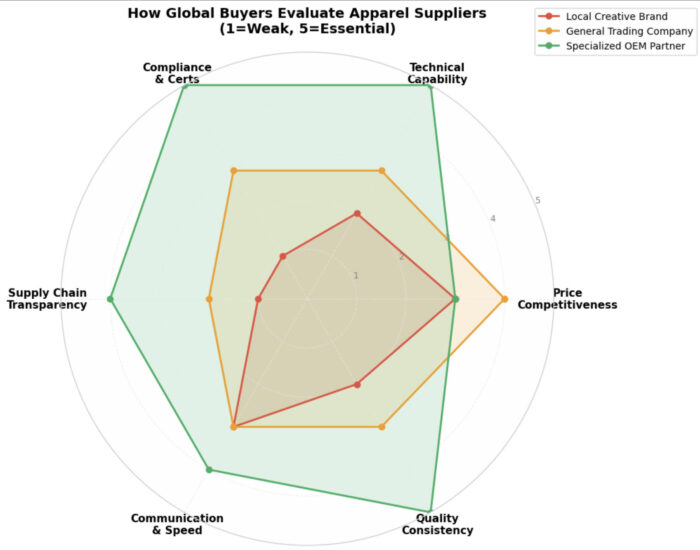
As the chart illustrates, global buyers do not evaluate suppliers on a single axis. A local creative brand may win on aesthetic originality but fails on compliance, transparency, and quality consistency. A general trading company wins on price but lacks technical depth. The specialized OEM partner—the position you should occupy—scores high on technical capability, compliance, quality consistency, and transparency, while maintaining competitive (though not necessarily lowest) pricing.
Your positioning goal is to move from the red zone toward the green zone.
Market Entry Strategy: Where to Start
Do not try to sell to every country simultaneously. Start with one market, prove the model, and expand.
Recommended entry sequence:
- United States: Largest apparel market, English-speaking, relatively straightforward compliance (CPSIA for children’s wear, FTC textile labeling). Buyers are accustomed to working with overseas manufacturers. The downside is high competition and demanding service expectations.
- United Kingdom / Australia: English-speaking, similar sizing standards to the US, strong e-commerce infrastructure. UK buyers are increasingly focused on sustainability documentation. Australian buyers pay premium prices due to limited domestic manufacturing but are sensitive to shipping costs.
- Germany / Netherlands: Sophisticated buyers, high compliance standards, strong demand for technical and sustainable apparel. Expect detailed audits and long onboarding processes. Once you are in, loyalty is high.
- Nordics (Sweden, Norway, Denmark): Extremely high sustainability expectations. GRS, bluesign®, and carbon footprint data are often mandatory. Premium pricing tolerance is high if you meet the standards.
Avoid entering the EU and US simultaneously unless you have dedicated compliance staff. The regulatory frameworks are different enough that a mistake in one market can drain the resources you need for the other.
Frequently Asked Questions
Q1: What is the most important factor for small apparel brands trying to attract global buyers?
A: Operational predictability. Global buyers prioritize suppliers who deliver consistent quality, on time, with compliant documentation, more than they prioritize creative design or low prices. A small brand that can produce a professional tech pack, pass a third-party audit, and ship samples with tracking numbers within 24 hours will win against a larger, disorganized competitor.
Q2: What certifications do global apparel buyers typically require?
A: Requirements vary by market and buyer type, but the most commonly requested are:
- OEKO-TEX Standard 100 (product safety, universal)
- BSCI or SA8000 (social compliance, EU/UK)
- ISO 9001 (quality management, universal)
- GRS (recycled content verification, sustainability-focused buyers)
- CPSIA (US children’s apparel mandatory)
- REACH (EU chemical compliance, often tested at the fabric level)
Start with OEKO-TEX and BSCI. They are the most cost-effective and widely recognized.
Q3: How should a small brand price its products for international wholesale?
A: Use the landed cost formula. Calculate your FOB factory price plus freight, insurance, and import duties to the buyer’s warehouse. Then ensure the buyer can achieve a 50–65% gross margin at their retail price. If your product lands at $15 and the market retail price for comparable goods is $35, the buyer’s wholesale cost would need to be $14–$17.50, leaving you no margin. Either reduce your cost, increase your technical differentiation to justify premium pricing, or target a different market segment.
Q4: What is the difference between positioning for local consumers and positioning for global buyers?
A: Local positioning emphasizes brand story, aesthetic differentiation, and emotional connection. Global positioning emphasizes technical capability, compliance, scalability, and risk mitigation. A local brand sells aspiration. A global brand sells reliability. Your website, sales deck, and catalog should lead with specifications, certifications, and production capacity—not founder narratives.
Q5: How can a small apparel brand compete with large manufacturers in Bangladesh or Vietnam on price?
A: You do not compete on price. You compete on specialization, speed, and service. Large factories in Bangladesh often have MOQs of 3,000–5,000 pieces and lead times of 60–90 days. A small, specialized OEM partner can offer 100-piece pilot runs, 15-day sampling, and direct communication with the production manager. Global buyers with niche products, tight deadlines, or complex technical requirements will pay 15–30% more for that flexibility.
Q6: What documentation should a small brand have ready before approaching global buyers?
A: At minimum:
- A professional capability deck with facility photos, machinery list, and capacity data
- Current certification certificates (PDF, with expiration dates visible)
- A fabric library with technical specifications and MOQs
- A sample tech pack showing your documentation standards
- A pricing matrix with volume tiers
- A compliance statement for your target markets (fiber labeling, care instructions, safety testing)
Q7: How important is supply chain transparency for international buyers?
A: Increasingly critical. EU and US retailers are under pressure from consumers and regulators to prove ethical sourcing. Buyers need to know your factory location, your material suppliers, your wastewater treatment, and your labor practices. You do not need to be perfect, but you need to be documented and honest. A supplier with a “Supply Chain” page showing actual mill names and audit dates is more trustworthy than one with a generic sustainability mission statement.
Q8: Should small apparel brands use trading companies or sell directly to global buyers?
A: Trading companies reduce your margin by 15–30% but handle communication, logistics, and payment risk. Direct sales preserve margin but require you to manage international shipping, customs documentation, and foreign exchange. In the early stage, use a trading company for your first 2–3 international buyers to learn the process. Once you understand Incoterms, letters of credit, and freight forwarding, transition to direct sales for accounts above a certain volume threshold.
Q9: What is the role of a tech pack in attracting global buyers?
A: A tech pack is your technical resume. It proves that you understand garment engineering and can execute consistently. When a buyer receives a complete, accurate tech pack with your initial proposal, they immediately categorize you as a professional supplier rather than a creative hobbyist. Invest in tech pack development before you invest in trade show booths.
Q10: How do global buyers evaluate quality in a small brand’s samples?
A: They evaluate fit consistency, construction durability, and color accuracy against the tech pack. They wash the sample multiple times. They check seam stretch recovery. They measure every point against the spec sheet. They also evaluate the packaging, the hang tag quality, and the professionalism of the shipping documentation. A sample that arrives in a crumpled polybag with a handwritten label suggests operational immaturity, regardless of the garment’s intrinsic quality.
Q11: What digital presence do global buyers expect from apparel suppliers?
A: A professional website with clear navigation, downloadable technical resources, and visible certifications. They expect an English-language capability deck, a “Contact” page with a real email address (not a Gmail account), and ideally a video walkthrough of your facility. They will also search for your brand name plus “review” or “scam” before placing a first order. Ensure your digital footprint is clean and professional.
Q12: How long does it take for a small brand to establish credibility with global buyers?
A: Typically 6–12 months from first contact to first purchase order. Global buyers move slowly. They request samples, conduct audits, negotiate terms, and place small test orders before committing to volume. The brands that succeed are those that maintain professional communication throughout this long sales cycle without becoming impatient or desperate. Your first international buyer is an investment, not a transaction.
Conclusion: From Local Label to Global Supplier
Positioning a small apparel brand for global buyers is not a marketing exercise. It is an operational transformation. The creative vision that built your local following is still valuable, but it must be packaged inside a technical infrastructure that international procurement teams can trust.
That means certifications, not just color palettes. It means tech packs, not just mood boards. It means landed cost calculations, not just retail pricing. It means supply chain transparency, not just sustainability slogans.
The good news is that small brands have structural advantages large factories cannot replicate: agility, specialization, and direct access to decision-makers. A buyer at a German sporting goods chain can email your factory manager and get a response in four hours. That same buyer emailing a 5,000-person factory in Vietnam might wait four days.
Your job is to make sure that when they do email you, what they find is a supplier who speaks their language—not just English, but the language of specifications, compliance, deadlines, and documentation.
That is how small brands become global brands. Not by being bigger. By being better prepared.
About the Author:
Technical production and international business development team at a custom sportswear manufacturing facility with 17 years of OEM experience. Specializations include B2B brand positioning, compliance consulting for EU and US markets, and small-batch production for emerging global brands.
Technical production and international business development team at a custom sportswear manufacturing facility with 17 years of OEM experience. Specializations include B2B brand positioning, compliance consulting for EU and US markets, and small-batch production for emerging global brands.
Last Updated: June 2026
Related Reading: