Introduction: The Set That Never Came
Last August, a club director from Southern California ordered sixty custom volleyball shirts for her U16 travel team. The supplier, a general athletic decorator she found through a referral, promised “moisture-wicking performance fabric” and a two-week turnaround. The price was competitive. The mockup looked clean. When the box arrived, the problems were immediate.
The fabric was 180gsm cotton-poly—soft to the touch, but heavy enough to cling to the players’ lower backs during the third set. The sleeves, described as “athletic cap sleeve,” had a drop-shoulder construction that restricted overhead arm swing. The sublimated numbers, promised to be “permanent,” began cracking at the edges after the second tournament. By the end of the season, half the team was wearing generic replacement shirts from a sporting goods store, and the club’s brand identity—carefully built over three years—was diluted every time they stepped on the court.
Volleyball is not a sport where apparel is an afterthought. It is a sport where a player’s uniform is under constant mechanical stress: explosive vertical jumps, rapid lateral movements, repeated overhead arm swings, and floor contact that abrades fabric at the hip and shoulder. A volleyball shirt that fits like a basketball jersey or a soccer kit will fail, because volleyball demands a different biomechanical profile.
Over seventeen years of manufacturing team sportswear, we have produced bulk orders for NCAA Division I programs, high school varsity teams, and club travel programs across the United States and Europe. This guide is what we tell every athletic director, club director, and procurement manager before they sign a purchase order for custom volleyball shirts.
The Biomechanical Reality: Why Volleyball Shirts Are Not Generic Athletic Wear
Before you evaluate fabrics or factories, you must understand what a volleyball shirt actually does during a match. Unlike soccer, where the primary motion is continuous forward running, or basketball, where the primary stress is lateral defensive slides, volleyball is a sport of intermittent maximum exertion with unique fabric stress points.
The Three Critical Stress Zones
1. The Shoulder and Armscye (Overhead Motion) A volleyball player executes roughly one hundred to one hundred fifty overhead arm swings per match—serving, spiking, and blocking. A standard T-shirt armhole (armscye) is designed for 90 degrees of arm elevation. A volleyball player routinely exceeds 180 degrees. If the armscye is too shallow, the side seam and sleeve binding restrict the follow-through, reducing power and causing chafing at the armpit.
2. The Torso and Lower Back (Extension and Floor Contact) Defensive specialists and liberos spend significant time in low, extended positions. The shirt must be long enough to remain tucked or to cover the lower back during a pancake dig. If the shirt is cut to standard basketball length (shorter in the torso), it rides up, exposing the lower back and creating a distraction.
3. The Hip and Side Panel (Lateral Movement and Abrasion) Quick lateral shuffles and floor dives create friction at the hip and side torso. Standard athletic knits without abrasion resistance will pill or fray at these contact points within a single tournament weekend.
A custom volleyball jersey manufacturer that does not account for these three zones is not manufacturing volleyball uniforms. They are decorating athletic blanks.
Fabric Technology – The Engine Underneath the Design
The fabric specification for volleyball shirts is the single most important technical decision in your bulk order. It determines thermoregulation, range of motion, durability, and decoration compatibility.
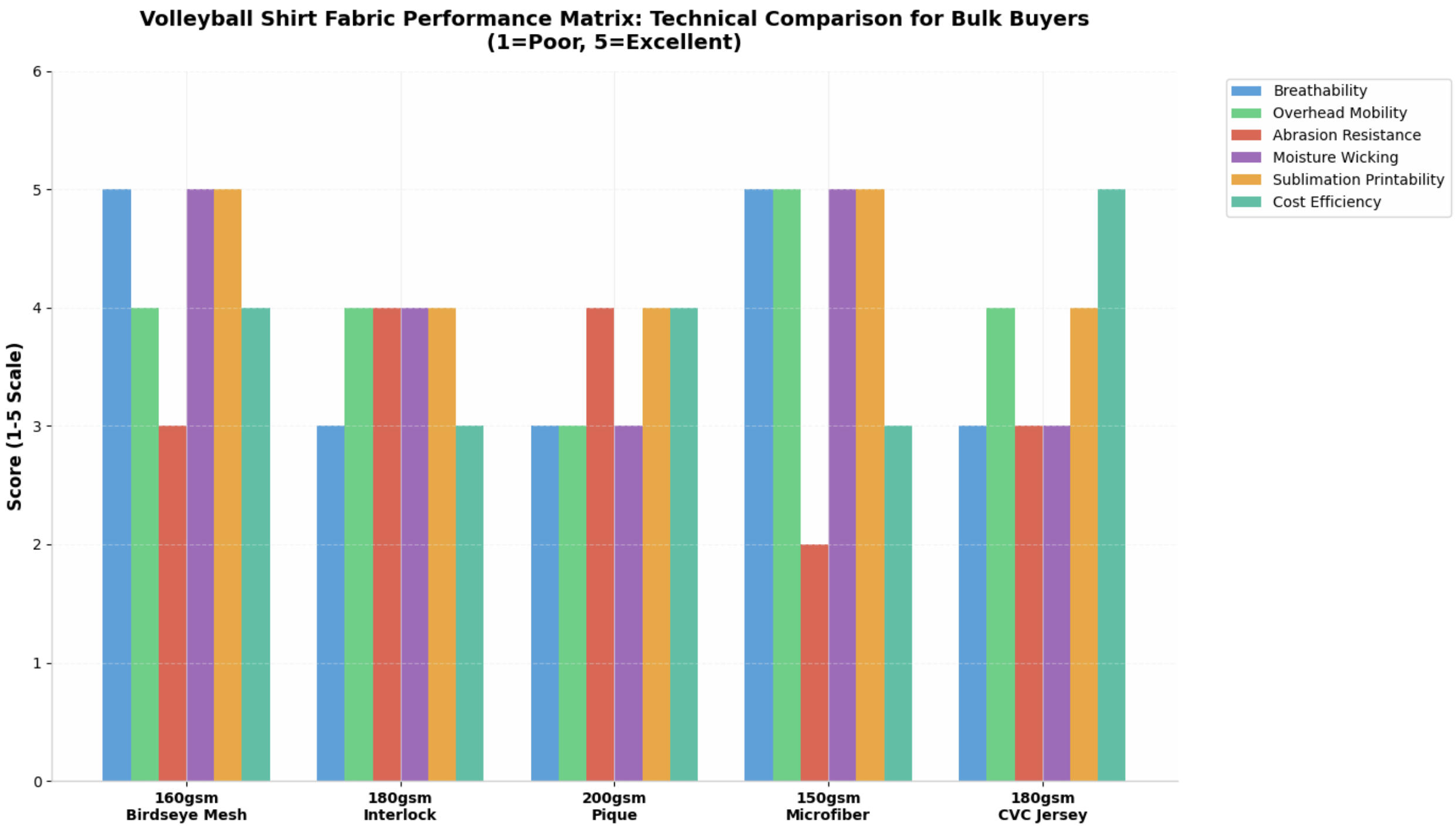
The Fabric Specification Matrix for Volleyball
160gsm Birdseye Mesh: The Competitive Standard
Birdseye mesh is the default recommendation for custom volleyball shirts in competitive play. The knit structure creates small, geometric ventilation pockets that allow air to circulate against the skin during high-intensity rallies. In our testing, birdseye mesh achieves an air permeability rate of 450–550 mm/s (ASTM D737), significantly higher than standard jersey knits.
For volleyball specifically, the 160gsm weight is optimal: light enough to prevent heat retention during long tournament days, but substantial enough to resist transparency when stretched across the shoulders during a serve. The primary limitation is abrasion resistance. Floor dives and repeated lateral contact will cause pilling at the hip after approximately twenty to thirty high-intensity matches. For club programs with heavy practice schedules, this means the shirts are a one-season garment.
180gsm Interlock: The Durability Play
Interlock double-knit provides superior structural stability. Because it is essentially two layers of jersey bonded together, it resists torque—the twisting distortion that causes shirts to skew after washing. For volleyball, this means the side seams remain aligned even after aggressive defensive movements.
The trade-off is thermal retention. Interlock is approximately 15% warmer than birdseye mesh. For indoor climate-controlled facilities, this is acceptable. For summer outdoor grass or beach volleyball tournaments, it is not. Interlock is best suited for high school varsity programs and recreational leagues where durability over multiple seasons matters more than maximum thermoregulation.
150gsm Microfiber: The Elite Option
For NCAA and semi-professional programs, 150gsm microfiber (50D/72F polyester) offers the highest performance ceiling. It is the lightest option, with the fastest moisture transport and the least resistance to overhead arm motion. However, it is also the least durable. A 150gsm shirt will show wear after ten to fifteen matches of floor contact. This is acceptable for programs that rotate kits frequently and have equipment budgets to replace annually. It is not acceptable for youth clubs that expect two to three seasons of use.
The Cotton Trap
We regularly receive inquiries for “cotton-feel” volleyball shirts. Cotton-poly blends (CVC) are comfortable for casual wear, but they absorb 7% of their weight in moisture (compared to 0.4% for polyester). In a three-set match, a CVC shirt becomes heavy, clingy, and thermally inefficient. For actual competitive volleyball, we strongly advise against cotton content above 35%. If a player insists on natural fiber for sensitivity reasons, specify a bamboo-derived modal blend with hydrophobic treatment—not standard cotton.
Sleeve Architecture – The Mobility Decision
Volleyball shirts come in three sleeve configurations, and the choice is not merely aesthetic. It is biomechanical.
Sleeveless (Tank / Racerback)
The default for men’s competitive volleyball and many women’s programs. The absence of sleeves eliminates all restriction on overhead arm swing. However, it also eliminates underarm protection from floor contact. For liberos and defensive specialists who spend significant time on the floor, sleeveless shirts can cause superficial abrasions at the armpit and shoulder cap.
Technical specification: If ordering sleeveless, specify a binding width of 2.5–3.0cm at the armhole. Narrower bindings (1.5–2.0cm) roll under stress and irritate skin. The binding should include 5% elastane for recovery after repeated stretching.
Cap Sleeve
The standard for women’s high school and club programs. The cap sleeve provides modest coverage and minimal restriction if engineered correctly. The critical error most manufacturers make is using a standard T-shirt cap sleeve pattern on a volleyball shirt. A standard cap sleeve is designed for 90 degrees of arm elevation. Volleyball requires 180 degrees.
Correct specification: The cap sleeve armhole must be dropped 2.0–2.5cm below the standard T-shirt armscye to allow full elevation without binding. The sleeve length should be 4–5cm from the shoulder seam—long enough to cover the shoulder cap, short enough to avoid interference with the blocking motion.
Long Sleeve
Increasingly popular for liberos and defensive specialists who want floor protection without the bulk of a separate pad. Long-sleeve volleyball shirts must be engineered with thumbhole cuffs to prevent the sleeve from riding up during a dig, and the fabric must be compression-weight (180–200gsm with 12–15% spandex) to prevent the sleeve from billowing during movement.
Warning: A long-sleeve volleyball shirt made from standard jersey knit will sag at the forearm and catch air during a swing. This is not a fit issue. It is a fabric specification issue.
Decoration Methods – What Survives a Season of Play
Volleyball shirts are decorated with team names, player numbers, sponsor logos, and club crests. The decoration method must survive repeated stretching, floor contact, and industrial laundering.
Dye-Sublimation: The Performance Standard
For custom volleyball shirts with all-over designs, complex patterns, or gradient colorways, sublimation is the only viable method. The dye bonds with polyester fibers at the molecular level, creating a permanent decoration that does not crack, peel, or add weight.
Volleyball-specific advantage: Because sublimation dyes the fabric rather than sitting on top of it, the decoration does not create a stiff area that restricts stretch. A sublimated panel on a spandex blend stretches uniformly with the fabric.
Limitation: Sublimation requires white or light-colored 100% polyester. Dark base colors require a white under-base layer or discharge printing, which changes the hand-feel.
Heat Transfer Vinyl (HTV): The Roster Solution
For player names and numbers that change seasonally, HTV is the practical choice. It allows mid-season roster changes without replacing the entire shirt. Modern TPU (thermoplastic polyurethane) vinyl achieves 8N/cm peel strength (ASTM D903) and survives 50+ washes.
Critical specification for volleyball: Because the shirt undergoes repeated overhead stretching, HTV must be segmented or stretch-compatible. Standard non-stretch vinyl will crack at the shoulder area after ten matches. Specify stretch HTV with a 30% elongation rating.
Tackle Twill: The Heritage Look
For club programs with established identities and multi-year roster stability, tackle twill (sewn fabric appliqué) offers the highest durability and the most premium aesthetic. It is the standard for NCAA programs.
Weight consideration: Tackle twill adds 60–90 grams to the chest or back of the shirt. For a lightweight 150gsm microfiber shirt, this weight addition can alter the drape and cause the front panel to sag. We recommend tackle twill only for shirts 180gsm and above, or with a reinforced interlining at the application point.
Embroidery: The Avoidance
We generally advise against embroidery on volleyball match shirts. The dense stitching creates a stiff patch that irritates the skin during floor contact and can catch on the net or opponent’s fingers during blocking. Embroidery is appropriate for staff polos and travel warm-ups, not for match-day jerseys.
Sizing and Grading for Volleyball Rosters
Volleyball players have distinct body proportions that differ from the general athletic population. Setters and defensive specialists tend to be leaner with longer limbs. Middle blockers and opposites tend to have broader shoulders and more muscular builds. A standard “unisex” size chart will fail your roster.
Gender-Specific Grading
Women’s Volleyball Block:
-
Torso length: Shorter than standard women’s athletic by 1.5–2.0cm to prevent riding up during jumps.
-
Chest ease: +6–8cm for compression fit; +10–12cm for standard fit.
-
Shoulder width: Wider than standard women’s grading to accommodate deltoid development.
Men’s Volleyball Block:
-
Torso length: Standard athletic length.
-
Chest ease: +8–10cm for compression; +12–14cm for standard.
-
Armscye depth: Deeper than standard by 2.0cm to accommodate overhead motion.
The Sample Set Strategy
Before placing a bulk order for custom volleyball shirts, request a graded size set (one of each size) and have your players try them on during actual practice. Do not rely on measurement charts. A player who measures as a “Medium” on paper may require a “Large” in the shoulders and a “Medium” in the torso. Volleyball-specific grading accounts for this disproportion.
Evaluating a Custom Volleyball Jersey Manufacturer
Not every factory that claims to produce “team uniforms” understands volleyball. Here is the due diligence checklist we recommend to every athletic director and club director.
1. Pattern Engineering Questions
Ask: “What is the armscye depth on your standard volleyball block, and how does it differ from your basketball block?”
If the factory does not have a dedicated volleyball block and tries to sell you a basketball or soccer pattern, they are not a custom volleyball uniform factory. They are a decorator.
2. Fabric Sourcing Transparency
Ask: “What is the filament count and denier of the polyester you recommend for competitive volleyball, and do you have test data for moisture regain?”
A factory that cannot tell you whether they use 50D/72F or 75D/36F is a factory that buys whatever is cheapest on the market that week.
3. Decoration Durability Testing
Ask: “Can you provide a wash-test report showing decoration adhesion after 25 industrial cycles?”
For sublimation, this is standard. For HTV, many factories have never tested beyond 5 washes. For volleyball, where shirts are washed after every tournament, 25 cycles is the minimum durability threshold.
4. Production Timeline Reality
Ask: “What is your actual production timeline for 100 pieces of a fully sublimated volleyball jersey, from approved sample to delivery?”
The honest answer is 15–20 business days for production, plus shipping. A factory promising 7 days is either cutting quality control or shipping blanks to a local decorator who will miss your technical specifications.
Cost Architecture and MOQ Strategy
Understanding cost drivers allows you to negotiate intelligently and avoid the “surprise upcharge.”
Cost Breakdown for a Standard Women’s Cap-Sleeve Volleyball Shirt (160gsm Birdseye, Sublimated)
| Cost Component | Percentage | Notes |
|---|---|---|
| Fabric | 30–35% | Birdseye mesh 160gsm; width 165cm; consumption ~0.35m per unit |
| Cutting & Sewing | 25–30% | Higher than T-shirts due to set-in sleeve and binding complexity |
| Sublimation | 15–20% | All-over print; ink load calibrated to 160gsm |
| Trim & Labels | 5–8% | Neck binding, care label, size label |
| Finishing & Packing | 5–8% | Individual polybag, team bundle packing |
| Factory Margin | 10–15% | Fixed; negotiate via volume, not margin squeeze |
FOB Price Benchmarks (per unit, at volume):
-
50 pieces: $18–$22
-
100 pieces: $14–$17
-
250 pieces: $11–$14
-
500+ pieces: $9–$12
The MOQ Reality: A true custom volleyball jersey manufacturer will offer 50-piece minimums for sublimated designs using their standard volleyball block. Below 50 pieces, you are paying sample-rate pricing ($25–$30 per unit) because the setup costs (pattern preparation, printer calibration, cutting markers) are amortized across fewer units.
Frequently Asked Questions
Q1: What is the best fabric for custom volleyball shirts in competitive play?
A: For indoor competitive volleyball, 160gsm birdseye mesh polyester is the industry standard. Its geometric knit structure creates natural ventilation pockets that achieve 450–550 mm/s air permeability, keeping players cool during high-intensity rallies. It is lightweight enough to avoid heat retention but substantial enough to prevent transparency when stretched overhead. For programs requiring multi-season durability, 180gsm interlock offers superior abrasion resistance at the cost of slightly reduced breathability.
Q2: What is the difference between a volleyball shirt and a standard athletic T-shirt?
A: Volleyball shirts are engineered for three biomechanical stresses that standard T-shirts do not address: (1) overhead arm swing requiring a dropped armscye (2.0–2.5cm below standard) to allow 180-degree elevation without binding; (2) torso extension requiring a longer back panel to prevent riding up during defensive dives; and (3) lateral floor contact requiring abrasion-resistant fabric at the hip and shoulder. A standard athletic T-shirt restricts spiking motion and exposes the lower back during play.
Q3: What sleeve style is best for volleyball: sleeveless, cap sleeve, or long sleeve?
A: Sleeveless is standard for competitive men’s volleyball and many women’s programs because it eliminates all arm restriction. However, it offers no underarm protection from floor abrasion. Cap sleeve is the most common for women’s high school and club play, but the armhole must be dropped 2.0–2.5cm below a standard T-shirt pattern to allow full elevation. Long sleeve is preferred by liberos for floor protection but must use compression-weight fabric (180–200gsm with 12–15% spandex) to prevent sleeve billowing during movement.
Q4: How durable is sublimation printing on volleyball jerseys?
A: Dye-sublimation is permanent on polyester. The dye converts to gas at 200°C and bonds with the fiber at a depth of 0.3mm. It does not crack, peel, or fade. In independent testing, sublimated volleyball jerseys maintain Grade 4–5 colorfastness (ISO 105-C06) after 50+ industrial washes. The decoration has zero hand-feel and stretches with the fabric, making it superior to screen printing or heat transfer for high-performance volleyball shirts.
Q5: What is the minimum order quantity (MOQ) for custom volleyball shirts?
A: A dedicated custom volleyball uniform factory typically offers 50 pieces as the minimum for fully sublimated designs using their standard volleyball block. Below 50 pieces, you pay sample-rate pricing ($25–$30 per unit) because setup costs are not amortized. For simpler designs using stock fabric with heat-transfer decoration, some factories offer 30-piece minimums. For NCAA and club programs ordering 100–250 pieces, standard FOB pricing is $11–$17 per unit depending on decoration complexity.
Q6: How do I ensure my volleyball team gets the right fit across all sizes?
A: Request a graded size set (one of each size) from your manufacturer and have your players try them on during practice before authorizing bulk production. Volleyball players have disproportionate shoulder-to-waist ratios compared to standard athletic grading. A setter may measure as a “Medium” in the waist but require a “Large” in the shoulders. Do not rely on generic size charts. A professional custom volleyball jersey manufacturer will offer gender-specific volleyball blocks with adjusted armscye depth and torso length.
Q7: Can I use cotton or cotton-blend shirts for volleyball?
A: We strongly advise against cotton content above 35% for competitive volleyball. Cotton absorbs 7% of its weight in moisture (compared to 0.4% for polyester), becoming heavy, clingy, and thermally inefficient during a three-set match. For recreational or practice environments where comfort is prioritized over performance, a CVC (65% cotton / 35% polyester) blend is acceptable. For competitive play, specify 100% polyester or a high-performance poly-spandex blend.
Q8: What should I look for when auditing a custom volleyball uniform factory?
A: Verify four capabilities: (1) Dedicated volleyball pattern block—not a repurposed basketball or soccer block; (2) Fabric test data—moisture regain, air permeability, and abrasion resistance reports for their recommended polyester; (3) Decoration durability testing—wash-test data showing adhesion after 25+ cycles; and (4) Production timeline transparency—honest answers about 15–20 day production windows rather than unrealistic 7-day promises. If a factory cannot show you a physical sample of a volleyball shirt with a dropped armscye, they are not a volleyball specialist.
Q9: How much should I budget for a bulk order of custom volleyball shirts?
A: For a standard women’s cap-sleeve volleyball shirt in 160gsm birdseye mesh with all-over sublimation, budget $14–$17 per unit at 100 pieces, $11–$14 at 250 pieces, and $9–$12 at 500+ pieces. Add $1.50–$2.50 per unit for individual player names (HTV). Add $3.00–$5.00 per unit for tackle twill numbers. Shipping (air express to the US) adds approximately $1.50–$2.00 per unit at 100+ piece quantities.
Q10: What is the difference between tackle twill and heat transfer vinyl for volleyball jersey numbers?
A: Tackle twill is sewn fabric appliqué that offers the highest durability (200+ washes) and a premium, dimensional aesthetic. It is the standard for NCAA programs. However, it adds 60–90 grams to the shirt and is permanent—roster changes require sewing new numbers over the old ones. Heat transfer vinyl (HTV) is faster to apply, allows mid-season roster changes (old vinyl can be removed and replaced), and is more economical. For youth clubs with annual roster turnover, HTV is the practical choice. For established programs with stable rosters, tackle twill is the premium choice.
Q11: How long does production take for custom volleyball shirts?
A: From approved sample to delivery, expect 15–20 business days for bulk production of 100–500 pieces, plus 3–5 days for air express shipping or 25–30 days for sea freight. Sampling takes an additional 7–10 days. Rush production (7–10 days) is possible at some factories using in-stock white fabric, but color options are limited to house stock. For tournament deadlines, plan 6–8 weeks from first contact to delivery.
Q12: Do volleyball shirts require special care or washing instructions?
A: Polyester volleyball shirts with sublimation decoration are low-maintenance. Recommend: machine wash cold with like colors, tumble dry low or hang dry, and avoid fabric softeners (which coat fibers and reduce wicking performance). For HTV-decorated shirts, turn inside out before washing to protect the vinyl edges. Do not iron directly over decoration. Tackle twill shirts can withstand industrial laundering and high-heat drying.
Conclusion: The Shirt Is Part of the System
Volleyball is a sport of precision. The set must be accurate to within centimeters. The spike must clear the block by millimeters. The dig must be timed exactly. The uniform should be held to the same standard.
A custom volleyball shirt that restricts an arm swing, rides up during a jump, or fails after ten washes is not just a defective product. It is a competitive disadvantage. It distracts the player. It undermines the club’s professional image. It turns a season-long brand asset into a single-season expense.
The retailers, athletic directors, and club directors who get this right are not the ones who find the cheapest supplier. They are the ones who find a custom volleyball jersey manufacturer that understands the biomechanics of the sport, specifies the fabric down to the filament count, and engineers the pattern for 180 degrees of overhead motion.
That is not a decoration service. That is a technical partnership. And it is the difference between a team that looks like they belong on the court and a team that looks like they are wearing hand-me-downs from another sport.
About the Author:
Technical production team at a custom sportswear manufacturing facility with 17 years of experience in team uniforms, including NCAA volleyball programs, high school varsity teams, and club travel organizations. Specializations include pattern engineering for overhead-motion sports, sublimation printing, and small-batch OEM production.
Technical production team at a custom sportswear manufacturing facility with 17 years of experience in team uniforms, including NCAA volleyball programs, high school varsity teams, and club travel organizations. Specializations include pattern engineering for overhead-motion sports, sublimation printing, and small-batch OEM production.
Last Updated: June 2026
Related Reading: