Introduction: The $8,000 Sublimation Mistake
In March 2025, a club director from Texas sent us a box of jerseys he had ordered from a supplier advertising “custom soccer jerseys manufacturer” services. The sublimation had looked vibrant in the supplier’s mockup. But when the players pulled them on for the first match, the numbers on the back began to crack at the edges before halftime. By the third wash, the chest logo had migrated two centimeters to the left, and the “navy” shorts were visibly a different shade from the “navy” jerseys.
The supplier had used a standard heat press at 165°C instead of the 200°C rotary drum required for proper dye penetration. They had printed on a cotton-poly blend instead of 100% polyester, which meant the sublimation dyes sat on the surface rather than bonding with the fiber. The club was out eight thousand dollars, and more importantly, they were out of time. The season had started.
This is not a rare story. It is the predictable outcome of buying from a decorator who calls themselves a custom soccer uniform manufacturer without understanding the molecular mechanics of sublimation printing.
Over seventeen years of operating a sublimation sportswear manufacturer facility, we have produced roughly 600,000 units for clubs, schools, Amazon sellers, and private-label brands. We have learned that the difference between a professional-grade kit and a disposable costume is not the design file. It is the engineering underneath.
This guide is written for the procurement manager, the club director, the startup brand founder, and the Amazon seller who needs to evaluate a custom soccer jerseys manufacturer before committing capital. It is technical, specific, and unapologetically focused on the details that determine whether your gear survives the season.
Why Sublimation Requires a Specialized Manufacturer
Sublimation is not “printing on a shirt.” It is a phase-change chemical process. At 180–200°C, solid disperse dyes convert directly to gas and bond with polyester fibers at a depth of approximately 0.3mm. This is permanent. The dye becomes part of the fiber. It cannot crack, peel, or fade in the way that screen-printed plastisol or heat-transfer vinyl can.
But this permanence depends on three variables that general decorators often get wrong:
1. Fiber Purity Sublimation requires 100% polyester, or a polyester content so dominant (minimum 85%) that the undyed fibers do not visually disrupt the design. A supplier who prints on cotton-poly “performance blends” is not producing sublimated jerseys. They are producing decorated jerseys with a short lifespan.
2. Temperature and Pressure Calibration A clamshell heat press at 165°C might work for a T-shirt transfer. It will not work for sublimation. Proper sublimation requires either a rotary drum heat press (continuous belt, 200°C, 30–40 seconds dwell time) or a large-format flat press with vacuum draw to eliminate ghosting. A custom soccer uniform manufacturer worth working with will have spectrophotometer verification to ensure Delta E color consistency below 1.5.
3. Bleed and Registration Control All-over sublimation requires printing on fabric before the garment is cut and sewn. This means the factory must have “print-to-cut” registration precision. If the printed pattern shifts by 2mm between the printer and the cutter, the side seams will not align, and the all-over pattern will look like a misaligned wallpaper job.
If your supplier does not have a dedicated sublimation floor with climate-controlled humidity (45–55% RH), they are not a sublimation sportswear manufacturer. They are a generalist who happens to own a heat press.
The Five Non-Negotiables When Evaluating a Custom Soccer Uniform Manufacturer
Before you send a deposit, validate these five capabilities. If any one is missing, you are not working with a manufacturer. You are working with a reseller.
1. In-House Fabric Sourcing and Testing
A legitimate custom soccer jerseys manufacturer does not buy random fabric from a trading market. They specify yarn denier, filament count, and knit structure to match the intended use.
For soccer specifically:
-
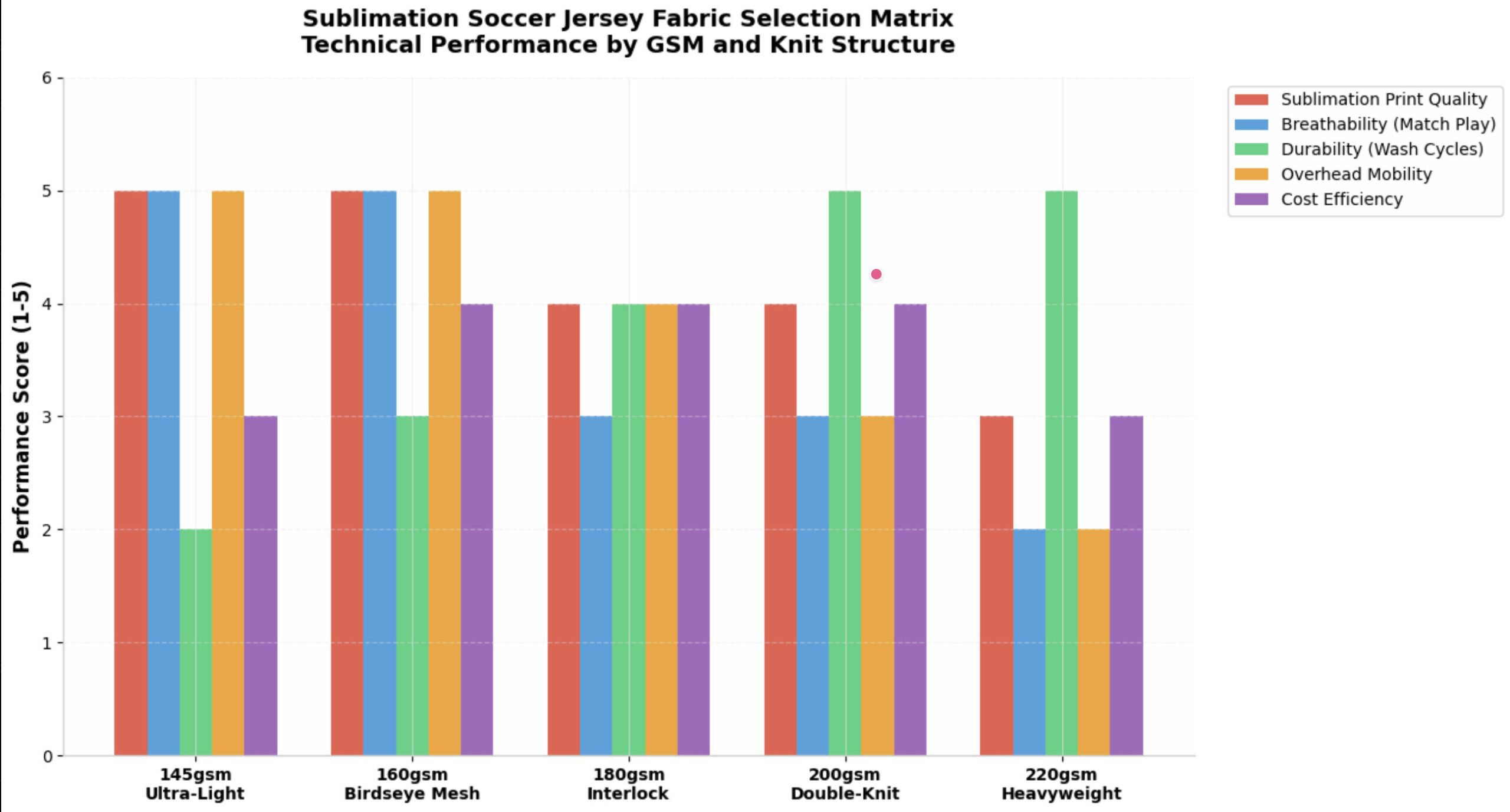
Match kits: 145–160gsm birdseye mesh or pique. Maximum breathability. Requires delicate handling.
-
Training kits: 180–200gsm interlock or double-knit. More durable for daily washing.
-
Goalkeeper kits: 220gsm+ with abrasion-resistant finish. Must survive repeated floor contact.
Ask for the mill name. Ask for the fabric test report (color fastness, shrinkage, moisture regain). If they cannot provide it, they are not controlling their supply chain.
2. Pattern Engineering for Athletic Biomechanics
Soccer is not a static sport. A jersey must accommodate 90 minutes of continuous cardio, overhead throw-ins, and defensive shoulder contact. The pattern block must reflect this.
Critical pattern specifications:
-
Armscye depth: Dropped 1.5–2.0cm below a standard T-shirt to allow full arm elevation without seam tension.
-
Torso length: Extended 2cm at the back hem to prevent the jersey from pulling out of shorts during low defensive positions.
-
Side seam position: Shifted slightly posterior to reduce friction during running.
-
Neck opening: Standard adult large = 44–46cm circumference for crew neck; 42–44cm for V-neck.
A factory that uses a generic “athletic fit” block for soccer jerseys is a factory that has never watched a match.
3. Decoration Method Portfolio
A professional custom soccer uniform manufacturer should offer multiple decoration methods and advise you on which is appropriate for your use case.
| Method | Best For | Durability | Cost Impact |
|---|---|---|---|
| Dye-Sublimation | All-over designs, gradients, photographic detail | Permanent (fiber-bonded) | Baseline |
| Tackle Twill | Permanent numbers/names, heritage aesthetic | 200+ washes | +$3–5/unit |
| Heat Transfer Vinyl | Roster changes, mid-season additions | 50+ washes | +$1–2/unit |
| Embroidery | Club crests on staff/travel gear | Very high | +$2–4/unit |
If the factory only offers sublimation and cannot explain when tackle twill is superior for number durability, they are a printer, not a manufacturer.
4. Compliance and Certification Documentation
For teams selling to the US market, or for brands selling on Amazon, compliance is not optional.
-
CPSIA: Required for youth jerseys (ages 12 and under). Lead testing and tracking labels.
-
OEKO-TEX Standard 100: Certifies freedom from harmful substances. Expected by EU buyers.
-
BSCI / SA8000: Social compliance. Required by institutional buyers and many EU retailers.
-
GRS: Global Recycled Standard. Increasingly necessary for brands with sustainability positioning.
A factory that treats certifications as “available on request” is a factory that does not have them current. Demand PDF copies with expiration dates.
5. Production Transparency and Communication
You should know where your order is at every stage.
Minimum transparency standards:
-
Fabric inspection photos within 24 hours of greige goods arrival.
-
Cutting room photos showing marker efficiency and layer count.
-
Inline QC checkpoint reports (every 10th unit).
-
Final inspection AQL report before shipment.
-
Tracking number within 2 hours of carton sealing.
If your account manager disappears for three days after you send the deposit, you do not have a manufacturing partner. You have a gamble.
Fabric Technology: The Sublimation Substrate Matrix
Not all polyester is equal. The yarn construction determines how the dye penetrates, how the fabric performs, and how long it lasts.
145gsm Ultra-Light (50D/72F Microfiber) The professional match standard. Used by clubs with equipment managers and frequent kit rotation. The 50D yarn creates a silky hand-feel and maximum dye uptake, producing the most vibrant sublimation results. The trade-off is durability. This fabric will show abrasion after 15–20 matches of slide tackles and will not survive the rough handling of youth recreational leagues.
160gsm Birdseye Mesh (75D/72F) The workhorse of competitive soccer. The geometric mesh structure creates natural ventilation pockets while maintaining enough structural integrity to survive a season of play. This is the default recommendation for most custom soccer jerseys manufacturer programs because it balances performance, printability, and cost.
180gsm Interlock (75D/144F) For training kits and colder climates. The double-knit construction provides horizontal stability (resisting the grab-and-pull of contact defense) but sacrifices approximately 20% breathability compared to birdseye. It is also less forgiving for all-over sublimation because the denser surface can show slight dye pooling at seam intersections.
200–220gsm Double-Knit / Heavyweight Reserved for goalkeeper jerseys, winter training, and fashion-forward fan replicas. The weight provides abrasion resistance but retains significantly more heat. For outfield players in warm climates, this is a dangerous choice. We have seen teams order 220gsm kits for summer tournaments in Texas and watch their players overheat by halftime.
The Yarn Specification That Matters When you specify fabric, ask for the denier (D) and filament count (F). A 75D/72F yarn has 72 micro-filaments bundled into a 75-denier thread. It feels smoother than a 75D/36F yarn because the individual filaments are finer. For sublimation, higher filament counts (72F, 96F, 144F) produce more uniform dye penetration and a softer hand-feel. A sublimation sportswear manufacturer that cannot tell you the D/F specification of their house fabric is buying commodity yarn.
From File to Finished Product: The OEM Workflow
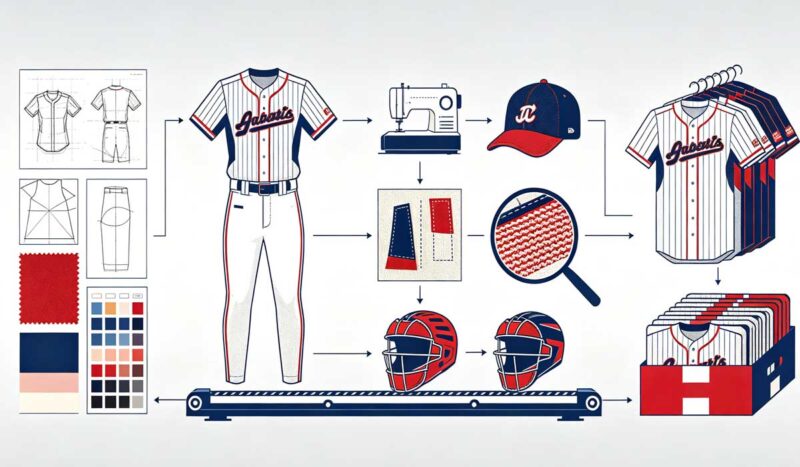
Understanding the production workflow allows you to set realistic timelines and catch errors before they become expensive.
Step 1: File Preparation and Validation You send your design file. A professional factory does not immediately print it. They validate it for print-readiness:
-
Resolution check: Is the file 300dpi at actual print size?
-
Color mode: Is it CMYK or RGB? Sublimation printers use CMYK inks, so RGB files will shift (reds often turn orange).
-
Bleed area: Does the background extend 2–3cm past the cut line? If not, the factory will add it, which may crop critical design elements.
-
Pantone matching: Are your colors specified with Pantone TCX codes? If not, the factory will guess.
Step 2: Digital Sampling Before cutting fabric, the factory produces a digital mockup showing the design on a 3D avatar or flat template. This confirms placement, scale, and proportion. For all-over sublimation, this step is critical because it reveals whether the pattern will align at the side seams.
Step 3: Physical Prototyping A single sample is produced in your specified fabric and size. This is your approval gate. Wash it. Stretch it. Have your players try it on. If the sample is wrong, the bulk will be wrong. Do not approve a sample based on photos alone.
Step 4: Fabric Procurement and Pre-Production The factory orders greige goods (undyed fabric) or uses in-stock white fabric. For color-critical programs, they reserve the entire dye lot to ensure batch-to-batch consistency. The fabric is relaxed for 24 hours in a climate-controlled room to prevent shrinkage after cutting.
Step 5: Sublimation Printing and Cutting The design is printed onto transfer paper using disperse dyes. The paper and fabric are fed through a rotary heat press at 200°C. The printed fabric is then laid out on an automated cutting table (Gerber or Lectra) and cut to the pattern pieces with ±0.5mm precision.
Step 6: Sewing and Assembly Panels are assembled using the specified seam types. For soccer jerseys, this typically involves overlock seams for standard construction and flatlock seams for stretch panels. The collar, cuffs, and hem are finished.
Step 7: Decoration Application (Post-Construction) If the design includes tackle twill numbers, heat-transfer names, or embroidered crests, these are applied after the garment is assembled. This sequencing prevents heat damage to pre-applied decorations during the sublimation process.
Step 8: Quality Control and Final Inspection The factory conducts inline checks during sewing and a final random inspection (AQL 2.5) before packing. A professional custom soccer uniform manufacturer will provide a QC report with photos of measured points.
Step 9: Packing and Shipping Garments are folded, polybagged, and cartoned according to your specifications. For Amazon FBA sellers, this includes suffocation warnings, UPC labels, and 22kg carton weight limits.
Total timeline from sample approval to delivery: 15–20 business days for production, plus shipping.
Pricing Architecture: What Drives the Cost of Custom Soccer Kits
Understanding cost drivers prevents sticker shock and allows you to negotiate from a position of knowledge.
Base Cost Structure for a Sublimated Soccer Jersey (160gsm Birdseye, Adult Size):
| Component | Cost at 100 Units | Cost at 500 Units | Cost Driver |
|---|---|---|---|
| Fabric | $3.50 | $2.80 | GSM, D/F specification, dye lot reservation |
| Sublimation | $2.50 | $1.80 | Ink coverage, all-over vs. placement, color count |
| Cutting & Sewing | $2.00 | $1.50 | Pattern complexity, seam type, labor market |
| Trim & Labels | $0.80 | $0.60 | Neck binding, care labels, size labels |
| Finishing & Pack | $0.70 | $0.50 | Polybag, carton, FBA prep (if applicable) |
| Factory Margin | $2.50 | $2.00 | Fixed overhead, QC, admin |
| Total FOB | $12.00 | $9.20 |
Variables That Increase Cost:
-
All-over print vs. chest logo: All-over sublimation requires more ink, more precise cutting, and higher fabric waste (bleed areas). Expect a 20–30% premium over placement print.
-
Individual names/numbers: HTV names add $1.50–$2.50 per unit. Tackle twill numbers add $3.00–$5.00 per unit.
-
Rush production: A 7-day turnaround typically carries a 20–30% surcharge because it disrupts the factory’s standard scheduling.
-
Sustainable materials: rPET (recycled polyester) with GRS certification adds 10–15% to fabric cost but qualifies for premium positioning and certain tax incentives.
The MOQ Reality: A true custom soccer jerseys manufacturer will offer 50-piece minimums for sublimated designs using their standard block. Below 50 pieces, you are paying sample-rate pricing ($18–$25 per unit) because setup costs (pattern preparation, printer calibration, cutting markers) are not amortized across enough units. For fully custom patterns (your fit, not the factory’s standard), expect MOQs of 100–200 pieces.
Frequently Asked Questions
Q1: What is a custom soccer jerseys manufacturer, and how is it different from a general decorator?
A: A custom soccer jerseys manufacturer controls the entire production process from fabric sourcing to finished garment. They specify polyester knit structures for sublimation compatibility, engineer patterns for soccer-specific biomechanics, and manage dye lot consistency. A general decorator buys pre-made blanks (often cotton-poly blends) and applies surface decoration. The manufacturer produces a garment engineered for the sport; the decorator applies a logo to a generic shirt. For bulk team orders or retail brands, the manufacturer offers technical control, consistent quality, and scalable production that a decorator cannot match.
Q2: What is a sublimation sportswear manufacturer, and why does sublimation require specialized equipment?
A: A sublimation sportswear manufacturer operates dye-sublimation equipment capable of bonding disperse dyes with polyester fibers at 180–200°C. This requires rotary drum heat presses or large-format vacuum flat presses, not standard clamshell heat presses. The factory must also maintain climate-controlled storage (45–55% relative humidity) to prevent paper distortion and color shift. Sublimation is a chemical process, not a surface application. It requires 100% polyester fabric, precise temperature calibration, and registration accuracy between printing and cutting. General apparel factories without dedicated sublimation floors cannot achieve the color consistency, penetration depth, or durability that competitive sportswear demands.
Q3: What fabric weight is best for custom soccer uniform manufacturer programs?
A: For competitive match play, 160gsm birdseye mesh polyester is the industry standard. It offers the optimal balance of breathability (450–550 mm/s air permeability), sublimation print quality, and single-season durability. For training kits subjected to daily washing, 180gsm interlock provides 20% more durability at the cost of reduced ventilation. For youth recreational leagues where cost is primary and performance is secondary, 200gsm pique is economical but thermally heavy. Professional clubs with equipment managers may specify 145gsm ultra-light microfiber for maximum breathability, accepting that it requires replacement after 15–20 high-intensity matches.
Q4: How do I evaluate whether a custom soccer uniform manufacturer is legitimate?
A: Verify five capabilities: (1) In-house fabric control—can they name the mill, provide the D/F specification, and show fabric test reports? (2) Pattern engineering—do they have a dedicated soccer block with adjusted armscye depth and extended back hem, or do they use a generic athletic block? (3) Sublimation equipment—can they show you a rotary drum press or vacuum flat press, not just a clamshell? (4) Compliance documentation—do they hold current OEKO-TEX, BSCI, or ISO 9001 certificates? (5) Production transparency—do they provide inline QC photos, cutting room documentation, and final inspection reports? If a factory cannot demonstrate all five, they are likely a trading company or decorator, not a manufacturer.
Q5: What is the minimum order quantity (MOQ) for bulk custom soccer jerseys?
A: For sublimated designs using the factory’s standard soccer block, 50 pieces is increasingly available from specialized manufacturers. For fully custom patterns (your own fit specifications, not the factory’s block), expect 100–200 pieces. Below 50 pieces, you pay sample-rate pricing ($18–$25 per unit) because setup costs for pattern preparation, printer calibration, and cutting markers are not amortized. Some factories offer “pilot run” programs for new clients at 30–50 pieces to establish a relationship before scaling to production volumes.
Q6: How long does production take from sample approval to delivery?
A: Standard production timeline is 15–20 business days after sample approval for orders of 100–500 pieces. Sampling itself takes 7–10 business days. Shipping adds 3–5 days (air express) or 25–30 days (sea freight). Rush production (7–10 days) is available at most factories but carries a 20–30% surcharge and typically requires using in-stock white fabric, limiting color options. For tournament deadlines, plan 6–8 weeks from first contact to delivery to allow for sampling revisions and shipping buffer.
Q7: What file format do I need to provide for sublimation printing on soccer jerseys?
A: The optimal file is a vector file (Adobe Illustrator .ai, EPS, or PDF) with fonts outlined and colors specified as Pantone TCX codes. If the design includes photographic or complex raster elements, provide a high-resolution PNG or PSD at 300dpi at actual print size. For all-over sublimation, extend background colors and patterns 2–3cm past the intended cut line (bleed area) to ensure full coverage at the seams. RGB files will shift color when converted to CMYK for sublimation printing. Low-resolution web images (72dpi) will pixelate when enlarged to garment scale.
Q8: How much should I budget for a bulk order of custom soccer jerseys?
A: For a standard 160gsm birdseye mesh jersey with all-over sublimation, budget $12–$15 per unit at 100 pieces, $9–$12 at 500 pieces, and $8–$10 at 1,000+ pieces. Add $1.50–$2.50 per unit for individual player names (HTV) and $3.00–$5.00 per unit for tackle twill numbers. Shipping to the US adds approximately $1.50–$2.50 per unit for air express at 100+ piece quantities. For fully custom patterns or rush production, add 20–30% to these benchmarks.
Q9: What is the difference between sublimation and tackle twill for soccer jersey numbers?
A: Sublimation dyes the number directly into the fabric as part of the all-over design. It is permanent, weightless, and stretches with the fabric. However, it is also permanent—roster changes require replacing the entire jersey. Tackle twill is a sewn fabric appliqué that creates a dimensional, textured number. It outlasts sublimation in abrasion testing (200+ washes) but adds 60–90 grams to the garment and requires sewing to change. For youth clubs with annual roster turnover, sublimation is more practical. For collegiate or semi-pro programs with stable rosters, tackle twill is the premium standard.
Q10: What certifications should I request from a soccer jersey manufacturer?
A: The essential certifications depend on your market: OEKO-TEX Standard 100 (product safety, universal expectation); BSCI or SA8000 (ethical labor, required by EU/UK buyers); ISO 9001 (quality management, universal); GRS (recycled content verification, for sustainability positioning); and CPSIA compliance (mandatory for US youth apparel ages 12 and under). For Amazon FBA sales, ensure the factory understands polybag suffocation warnings, scannable UPC labeling, and 22kg carton weight limits.
Q11: How do I ensure color consistency across multiple orders of the same soccer jersey design?
A: Demand dye lot control from your manufacturer. This means the factory purchases the entire season’s fabric requirement from a single production batch or reserves the exact dye formula for your color. Insist on spectrophotometer verification (Delta E ≤ 1.5) for every bulk shipment. For critical programs, approve a “lab dip” (mini dye sample) before each production run. Keep a sealed physical swatch of your approved color as the master standard. Without these controls, a reorder in six months may not match the original batch.
Q12: Can a sublimation sportswear manufacturer produce dark-colored soccer jerseys?
A: Sublimation dyes are transparent. They cannot cover a dark base fabric. To produce dark jerseys (black, navy, dark red) with bright logos, the manufacturer must use one of three methods: (1) White-base sublimation, where a white layer is printed first and colored dyes are applied on top—this adds cost and slightly stiffens the fabric; (2) Discharge printing, which bleaches the dark dye and replaces it with pigment—less durable than true sublimation; or (3) Hybrid decoration, where the body is sublimated on white fabric and dark panels are sewn in as color-blocked pieces. A professional custom soccer jerseys manufacturer will advise you on the trade-offs of each approach.
Conclusion: The Manufacturer Is the Product
When you are evaluating a custom soccer jerseys manufacturer, you are not just buying a garment. You are buying a supply chain, a quality system, and a technical partnership. The cheapest quote is rarely the best value. The fastest timeline is rarely the most reliable. The factory that asks the most questions before quoting is usually the one that will cause the fewest problems after production.
Sublimation is a permanent technology. When it is done correctly, the dye becomes part of the fiber and the design survives the season, the tournament, and the washing machine. When it is done incorrectly, you have three hundred units of expensive evidence that your supplier was not a manufacturer at all.
The difference lies in the details that most buyers never think to specify: the denier and filament count of the yarn, the temperature calibration of the heat press, the armscye depth of the pattern, the Delta E tolerance of the color lab. These are not luxuries. They are the minimum standards of a professional custom soccer uniform manufacturer.
If you are building a team, a brand, or a retail line that needs to survive beyond a single season, invest in a partner that understands this. Your players will not care about your supplier’s ISO certificate. They will care whether their jersey fits, breathes, and looks identical in the final match of the season to the first. That is what a real manufacturer delivers.
About the Author:
Technical production team at a sublimation sportswear manufacturing facility with 17 years of OEM experience. Specializations include dye-sublimation engineering, soccer kit pattern development, and bulk team uniform production for clubs, schools, and private-label brands across North America and Europe.
Technical production team at a sublimation sportswear manufacturing facility with 17 years of OEM experience. Specializations include dye-sublimation engineering, soccer kit pattern development, and bulk team uniform production for clubs, schools, and private-label brands across North America and Europe.
Last Updated: June 2026
Related Reading: